Operations 26 November 2026
The Backup Warehouse Is Not the Backup Record
A distribution center fire showed how quickly medical supply networks can reroute products. Tray and loaner operations need the same resilience at the asset level.
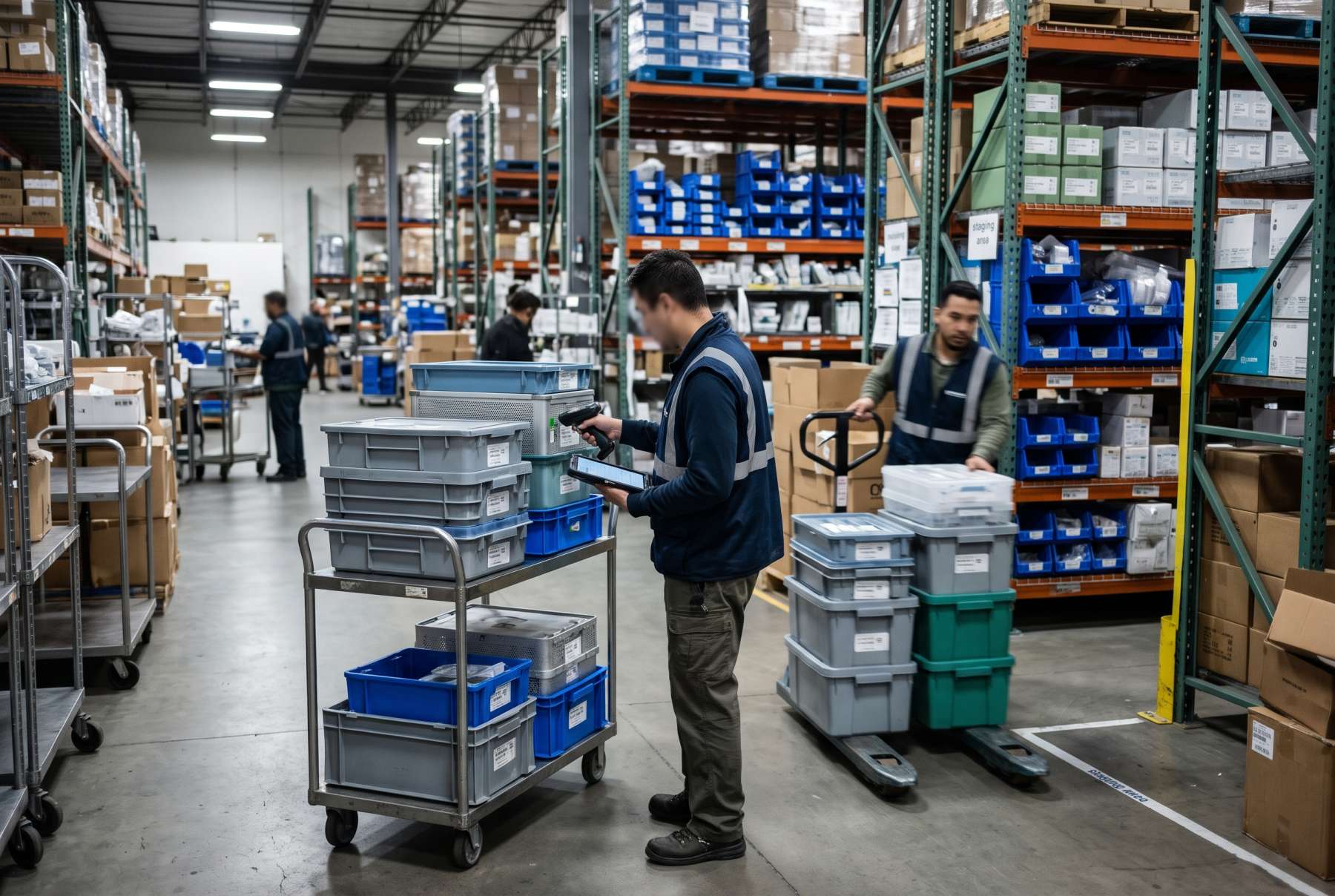
A backup warehouse can keep products moving. It cannot, by itself, tell a surgical team which tray is available, which one is committed to a case, or which one disappeared during the reroute.
That distinction became real for the medical supply industry after a June 11, 2026, fire destroyed Medline's distribution center in Tracy, California. Medline activated a contingency plan, reassigned product to other facilities, increased transportation capacity, and later leased more than 1.6 million square feet of replacement distribution space in Northern California. In its November 4 filing, the company reported $416 million in estimated losses related to the fire for the first 9 months of 2026, before insurance recoveries and final claims resolution. The response shows what a large network can do when a node disappears. It also raises a harder question for tray and loaner operations: what happens to the record when the physical network changes faster than the system tracking the assets?
For disposable supplies, rerouting an order may be enough to preserve service. For surgical trays, loan sets, and implant totes, the operation has to preserve more than delivery. It has to preserve identity, custody, location, processing status, and the connection to the next case.
A rerouted shipment is not a reconciled asset
In a disruption, the first operational objective is understandable: get critical products out of the affected node and into the hands of customers. That can mean moving inventory to a secondary distribution center, adding carriers, creating relay routes, or using temporary warehouse space. Medline described each of those steps in its response to the Tracy fire, including a command center, secondary and tertiary distribution centers, regional staffing, and additional transportation capacity.
Those measures address network capacity. They do not automatically address asset accountability.
A surgical loaner set may be staged for a case when the original warehouse becomes unavailable. It may be transferred to another facility, assigned to a third-party logistics partner, placed on a different carrier route, or delivered directly to a hospital or ASC. Several teams may update their own spreadsheets during the handoff. The manufacturer may see a shipment released. The distributor may see an order in transit. The field representative may believe the set is at the customer. Sterile processing may be waiting for an expected arrival that has not actually occurred.
Every entry can be locally reasonable while the shared picture is wrong.
This is the difference between a network that can move inventory and a network that can explain inventory. In normal conditions, a missing explanation produces phone calls and extra labor. During a disruption, it can create duplicate shipments, unnecessary emergency loaners, and a false sense that the case is covered because something with the right name was shipped.
Resilience has to follow the tray, not just the facility
The medical device industry is putting more attention on distributed operations. The Defense Health Agency is examining off-site sterile processing as a potential way to support 21 military hospitals, after equipment failures and contamination events reduced surgical capacity at affected facilities. The analysis described by Healthcare Purchasing News includes transportation reliability, instrument tracking, tray availability, emergency turnaround, and accountability for quality.
That list matters because off-site processing changes the number of places where a tray can wait. A set can leave the hospital, arrive at a processing center, move through decontamination, wait for inspection, enter sterilization, transfer to a staging area, and then travel to another facility. Each step may be controlled by a different team. A service contract can define responsibilities, but it does not make the asset visible between handoffs.
The same issue appears when a distribution network is recovering from a fire, cyber incident, weather event, labor disruption, or facility closure. The backup site becomes part of the operating model. A 3PL becomes part of the custody chain. A temporary staging area becomes a real inventory location. If the tracking record still assumes that the original warehouse is the center of the network, every exception becomes manual.
Asset-level visibility changes the question from “Which facility is serving this region?” to “Where is this specific set, and what has to happen before it can support the case?” That is a more useful question for the manufacturer, the distributor, the field team, the hospital, and sterile processing.
Case readiness is the test of the contingency plan
Contingency planning is often measured by throughput. How many orders were rerouted? How many trucks were added? How quickly did the replacement warehouse open? Those are important measures, but they stop short of the clinical operating consequence.
For surgical assets, the better test is whether the right set was visible early enough to be inspected, processed, staged, and used without a last-minute search.
That requires a shared record across the organizations involved. The manufacturer needs to know whether a loan set is still in the regional network or has been committed to a case. The distributor needs to distinguish a set in transit from one received but not reconciled. The field representative needs to see whether an asset is available or already tied to another procedure. The hospital and ASC need more than a tracking number. They need confidence that the expected tray is physically present and moving through the next required step.
Real-time tracking supports that shared picture when assets move through warehouses, hospitals, ASCs, sterile processing departments, and field operations. A custom autoclavable tag can keep the identity attached to the tray through processing instead of allowing visibility to end at the receiving dock or decontamination area. Case scheduling can then be compared with the location and availability of required trays, while inventory auditing can help teams reconcile what was rerouted, received, or still missing.
The point is not that tracking software can prevent a warehouse fire or replace a business continuity plan. It cannot. It can make the plan explainable at the point where a case depends on one particular asset.
That is also where the economics become clearer. An unverified tray can lead to an emergency shipment, a duplicate loaner request, avoidable courier expense, idle field inventory, or a delayed procedure. Those costs do not always appear in the warehouse recovery report. They show up later, spread across operations, clinical teams, manufacturers, and customers.
A resilient device network is not simply one with alternate buildings and extra carriers. It is one where the identity and status of every critical asset survive the disruption. The backup warehouse matters. The backup record matters more, because that is what tells the next team whether the tray is actually ready.
Frequently asked questions
What should distributors track when a loaner set is rerouted to another facility?
Track the specific set, its current location, custody, availability, and the next required step. A shipment status alone cannot show whether the asset was received, reconciled, processed, or committed to a case.
How can a manufacturer tell whether a backup shipment actually protects a scheduled case?
Compare the scheduled procedure and required trays with current asset location and availability. Hansel's case scheduling and surgical tray tracking capabilities support that comparison across manufacturers, distributors, field teams, and care sites.
Does asset-level tracking replace a warehouse or business continuity plan?
No. Alternate facilities, carriers, staffing, and temporary storage still address the physical recovery of the network. Asset tracking adds the shared record needed to explain where critical trays and loan sets are after those changes occur.
What visibility is useful when a 3PL or off-site processing center takes custody of a tray?
Teams need to distinguish an asset that is in transit from one that has arrived, been reconciled, entered processing, or is ready for the next case. Real-time tracking helps manufacturers, distributors, 3PLs, hospitals, and sterile processing teams work from the same asset picture.
How can operations teams reconcile trays after an emergency reroute?
Use inventory auditing to compare what was released, transferred, received, committed, and still missing at the asset level. This helps identify duplicate shipments and unresolved handoffs instead of relying on separate spreadsheets and assumptions.
Where do the costs of poor tray visibility show up during a disruption?
The impact may appear as emergency courier charges, duplicate loaner requests, idle field inventory, extra reconciliation labor, or a delayed procedure. Connecting asset movement with availability and case requirements makes those operational consequences easier to identify and manage.