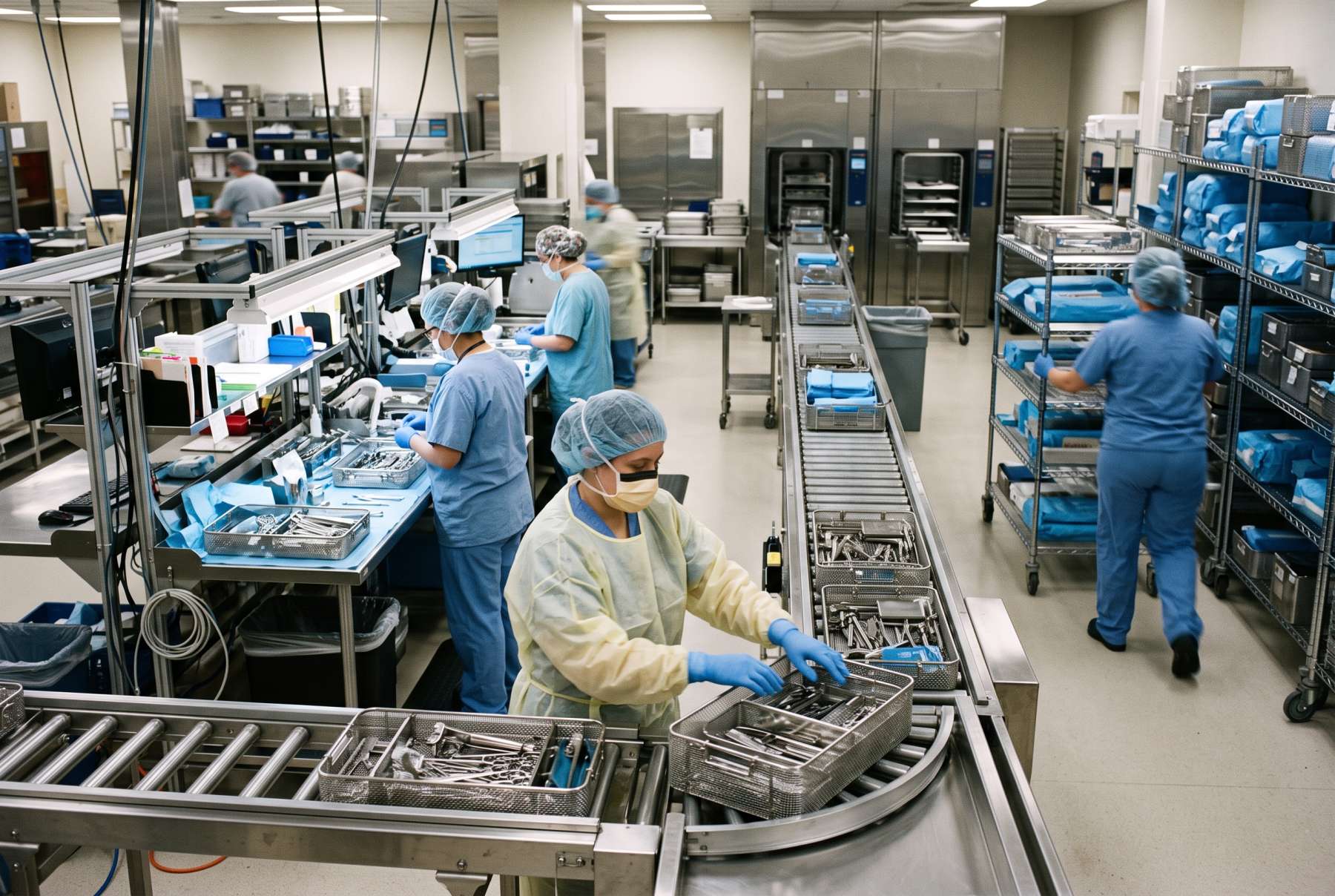
The surgical technologist shortage is usually described as a hiring problem. The sterile processing shortage is described the same way. Both descriptions are accurate, but incomplete.
The operational problem is also what happens to the staff who are already on the floor when a tray cannot be found. A coordinator leaves the board. An SPD technician pauses assembly. A field representative gets a phone call. Someone checks the loading dock, the clean room, the loaner cabinet, and the operating room that used the set last. The work is rarely recorded as a staffing expense, but it consumes the same scarce labor.
That matters because hospitals and ASCs are trying to protect surgical capacity with fewer people and more variable case loads. Becker's Hospital Review reported in July 2026 that some health system leaders rank the surgical technologist supply and demand issue alongside the nursing shortage as a threat to keeping operating rooms open. In February 2026, AORN described staffing shortages as a pressure on efficiency and patient safety targets.
In that environment, tray hunting is not a minor inconvenience. It is an unplanned staffing model.
The missing tray creates a second case
When a required set is not where someone expected it to be, the first response is usually a search. That sounds reasonable. The problem is that a search rarely has one owner or one stopping point.
The OR may ask sterile processing whether the tray was received. Sterile processing may ask materials management whether it was transferred. Materials management may ask the distributor or manufacturer representative whether it went to another facility. The field team may check a vehicle, a rep's home storage area, or another hospital on the same route. Each person may have part of the truth, but nobody has the full operating picture.
Manual processes make this worse because they preserve actions rather than current state. A barcode scan can prove that a tray was scanned at a particular moment. A spreadsheet can show that a set was assigned to a case. A phone call can confirm that somebody saw it earlier in the day. None of those records reliably answer the question the case team needs answered now: where is the asset, and is it close enough to be useful?
The labor cost is not only the minutes spent walking. It is the interruption cost. A senior SPD technician is pulled away from assembly. A coordinator stops balancing the day's workload. A field representative spends time reconstructing movement instead of preparing the next case. A surgeon's office may receive a late update because the team is still trying to establish whether the set is missing or merely sitting in the wrong location.
This is why a staffing shortage changes the value of visibility. When labor is plentiful, a manual search can hide inside the day. When labor is tight, the same search competes directly with tray inspection, case preparation, turnover, and patient flow.
Visibility has to survive the part of the process people cannot see
Most organizations can tell themselves that an asset is visible because it appears somewhere in a system. The harder question is whether visibility survives the handoffs that matter.
A loaner set may be received at a hospital, moved into sterile processing, placed through decontamination, sterilized, staged for a case, opened in the room, and returned to a warehouse or another site. If the record goes dark at the dock or during sterilization, the team is forced to rebuild the chain from memory and messages.
That is why the tag and the process have to be designed around the actual life of the asset. Hansel's tracking model uses an autoclavable tag that remains on the tray, loaner set, or implant tote through decontamination and sterilization. Beacons and gateways report presence against a site structure that can include warehouses, hospitals, ASCs, and sterile processing locations. The point is not to create a perfect story about every movement. It is to maintain a reliable operating picture when a manual scan or phone call would otherwise become the only evidence.
A useful location record does not need to pretend that it knows more than it does. It can show the last reliable sighting, how long the asset has been at a site, and when it was last seen. If the asset has no current site, the honest operational interpretation is that it is in transit, not that the system has somehow placed it at a street address.
That distinction matters to understaffed teams. A coordinator deciding whether to wait for a set, substitute another tray, or escalate to a manufacturer does not need a decorative map. The coordinator needs to know whether the set is in the hospital, still in sterile processing, sitting at a warehouse, or moving between sites.
The same visibility also helps separate a location problem from a readiness problem. A tray can be on site but not assembled. It can be in sterile processing but held because an item is missing. It can be in the OR but assigned to the wrong case. The answer to "where is it?" is necessary, but not sufficient.
The next efficiency gain is fewer interruptions, not faster people
Healthcare operations often respond to capacity pressure by asking staff to move faster. That approach has limits. A technician cannot safely skip inspection. A field representative cannot remove every handoff from the day. A coordinator cannot make a delayed shipment arrive by working through another lunch.
The more durable opportunity is to remove avoidable interruptions from the workflow.
That starts with making exceptions visible before they become urgent. A case readiness process should show which item is missing, which step is holding the work, who owns the next action, and what has been released. A shared board is more useful when it represents unfinished work rather than simply displaying a case name. Missing item checks, stage holds, and operational alerts can keep a case from appearing ready merely because it exists on a calendar.
This is also where scheduling and asset operations need to meet. The question is not only whether a procedure is scheduled for Thursday. It is whether the required tray is moving toward the right site, whether it has been processed, whether any component is missing, and whether the people responsible for clearing the exception know about it early enough to act.
AORN's July 2026 review of OR efficiency metrics emphasized that organizations often struggle to answer basic questions about late starts, turnover time, utilization, and documentation work. Those questions are not solved by adding another report after the case. They are solved by capturing the operational state close to the point where work happens.
For trays and loaners, that means treating movement, sterilization, assignment, and exceptions as part of the same operating record. It also means giving the field, warehouse, SPD, and clinical teams a common view. When each group maintains its own version of the truth, every shortage becomes more expensive because the organization spends scarce labor reconciling records instead of moving the case forward.
Recent work at OHSU offers a useful parallel. Becker's reported that OHSU reclaimed roughly 25 hours per week of nurse manager and service line coordinator time through a more data-informed approach to staffing and coordination across 53 operating rooms. The lesson is not that every hospital needs the same system. It is that capacity can be recovered from coordination work that was previously treated as unavoidable.
The same principle applies to surgical assets. A search for a tray may feel like part of the job, but repeated searches are a sign that the operating model is asking people to supply the visibility that the system does not provide.
The staffing shortage is therefore not only a reason to recruit, retain, and train. It is a reason to examine every task that pulls trained people away from work that requires their judgment. Finding a missing tray is sometimes necessary. Making five people reconstruct its last known movement should not be.
When an organization measures tray visibility only by whether someone can eventually find the asset, it misses the capacity problem. The sharper measure is how many interruptions were required to establish where the asset was, whether it was ready, and who needed to act next.
That is the operational test. In a constrained workforce, visibility is not a convenience layered on top of the process. It is part of how the process protects the workforce it has.