The most important phrase in CMS's 2027 outpatient proposal may not be a payment rate. It is the proposal to remove 638 services from the inpatient only list over the second year of a three year phase out.
That change would give physicians more flexibility to perform certain procedures in hospital outpatient departments and ambulatory surgery centers when clinically appropriate. It also creates a practical question for every medical device operation supporting those cases: can the required trays, loan sets, and implant inventory follow the procedure to the site where the case now belongs?
CMS's 2027 OPPS and ASC proposed rule would affect approximately 3,500 hospitals and 6,400 ASCs. The policy is still proposed, not final. The operating direction, however, is familiar. More procedures are being evaluated across more sites, while the inventory supporting them remains finite, mobile, and often shared.
The procedure can move faster than the tray network
When a procedure shifts from an inpatient setting to an outpatient department or ASC, the clinical decision is only the first move. The supporting equipment has to be staged, inspected, sterilized, assembled, transported, received, and made available at the correct time.
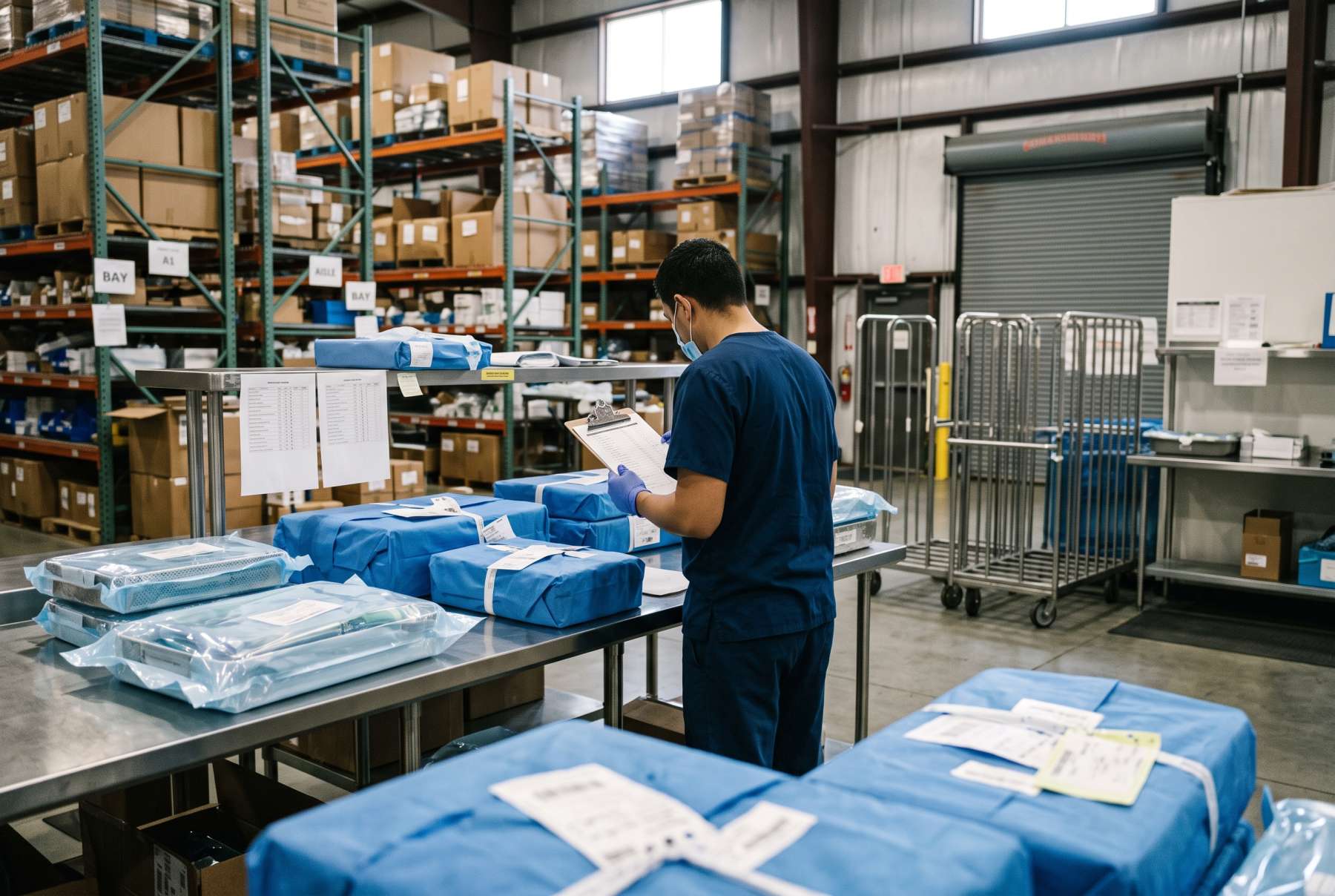
That sounds straightforward until the same loaner set is supporting cases at several facilities in the same health system. A tray may be at a hospital after a previous case, in sterile processing waiting for inspection, with a field representative, at a distributor warehouse, or already moving toward an ASC. The schedule may show the new case location clearly. The asset record often does not.
This is where an outpatient shift becomes an operations problem rather than a simple scheduling update. The network has more potential destinations, more handoffs, and less tolerance for a late discovery. A set that was easy to locate when all cases were concentrated in one hospital can become a constraint when the same inventory pool is spread across an IDN, affiliated ASCs, a 3PL, and manufacturer loaner channels.
The obvious response is to add more inventory. Sometimes that is appropriate. But buying another tray does not solve the underlying question if nobody can tell which set is available, which one is already committed, which one is in decontamination, or which one has not arrived at the receiving site.
Readiness is more than knowing where the container is
Location is necessary, but it is not the whole readiness decision.
A case can fail readiness even when the outer tote is sitting in the correct building. The set may be incomplete. An implant kit may still be missing a component. The instruments may be waiting for decontamination or inspection. A tray may have arrived at the hospital but not yet reached the sterile processing workflow. The schedule may say the case is tomorrow, while the operational record still depends on a phone call to determine whether the inventory is usable.
That distinction matters as procedures move between hospital outpatient departments and ASCs. The question is not simply, “Where is the tray?” It is, “What still has to happen before this tray can support this case at this site?”
A useful operating model separates at least 3 conditions:
- Asset location: the last known site of the tray, loaner, or implant tote.
- Asset condition: whether it is in transit, at a site, in sterile processing, on hold, or otherwise unavailable.
- Case readiness: whether the required inventory and procedural steps are complete for the scheduled case.
Those conditions are related, but they are not interchangeable. A live location can prevent a search. It cannot replace inspection, decontamination, assembly, or release. Conversely, a case readiness board that does not include reliable asset movement can become a set of optimistic status labels.
The operational gain comes from connecting the two views. A scheduling team should be able to see the upcoming procedure. The field or loaner team should see the required assets and their current locations. Sterile processing should retain control over the safety-critical work that must happen before release. The common picture is what prevents each group from building a separate version of the truth.
Outpatient growth will expose exception work first
Routine cases rarely reveal a weak tracking model. The tray arrives, the case proceeds, and the missing data remains invisible. The exceptions are more instructive.
Consider a case moved from a hospital operating room to an ASC after the schedule changes. The required loan set is still at the hospital. A coordinator notices the conflict during a manual review, texts the representative, and begins asking whether the tray can be cleaned and transported in time. If the set is not found immediately, the team starts widening the search across the warehouse, receiving dock, sterile processing department, and other sites.
That work is often described as a scheduling issue. In reality, it is an exception workflow caused by disconnected asset and case information.
A stronger process gives the exception a visible owner and a defined stage. The item can be marked as missing, held until a component is confirmed, escalated when an asset remains too long at a site, or released when the readiness condition is satisfied. Notifications should reach the people who can act, rather than leaving the issue on a dashboard that nobody is watching.
That approach also changes the conversation with a 3PL or manufacturer. Instead of asking for a general status update, the network can ask a narrower question: which asset is blocking this case, where was it last seen, what step is incomplete, and who owns the next move?
For distributors and manufacturers, the same visibility helps separate true demand from avoidable duplication. If a tray is repeatedly classified as unavailable because it cannot be located, the business may purchase or position more inventory than it actually needs. If the problem is that the tray is visible but consistently held up at a particular handoff, the corrective action is different.
The new site of care is also a new logistics promise
CMS's proposal is about payment and site-of-service policy. The operational consequence is broader. Every additional site that can perform a procedure becomes another place where the inventory chain must be understood.
That does not mean every asset needs to be permanently assigned to one facility. Shared inventory can be efficient. Loaner models can work. A regional warehouse can support multiple ASCs. The requirement is that the network knows what is shared, where it is, what it is doing, and whether it can be ready in time.
For medical device operations, the sharper measure is not how many procedures can theoretically move outpatient. It is how many can move without creating a new layer of hunting, duplicate safety stock, emergency transport, or last minute calls.
The procedure may move from the hospital to the ASC in a scheduling system. The tray still has to make the journey through the physical system. If that journey is not visible, the organization has not really expanded capacity. It has moved uncertainty to another dock.
As outpatient policy continues to reshape where cases happen, readiness should be treated as a network condition, not a location label. The winning operation will not simply know which site owns the case. It will know which asset supports it, what remains incomplete, and when the case can be considered genuinely ready.