Restored shipping is not the same as restored readiness.
That distinction became visible during the Boston Scientific cyber incident that began on August 25, 2026. The company reported that the event disrupted access to internal systems used to process and ship customer orders. Hospitals could continue submitting some orders, but fulfillment was delayed while the manufacturer worked through the outage and the resulting backlog. The American Hospital Association's report described the disruption as an operational problem affecting order processing and shipping. Boston Scientific later reported that its distribution network had substantially recovered, while also noting that the backlog still had to be worked down. The company's September 5 update made the point plainly: distribution was moving again, but recovery was still a process.
For medical device distributors, manufacturers, 3PLs, hospitals, and ASCs, the lesson is bigger than cybersecurity. When a system outage, weather event, carrier failure, recall, or supplier interruption releases a wave of delayed inventory, the first operational question is not whether the shipment has left the building. It is whether the receiving network knows what actually moved, where it is now, and what work remains before the asset can support a case.
A released order can still be an unresolved asset
In a disruption, teams naturally measure recovery by the signals they can see first: orders are accepted, labels are printed, carriers have pickups, and the manufacturer portal is available again. Those are important signals. They are not the same as a reliable inventory picture.
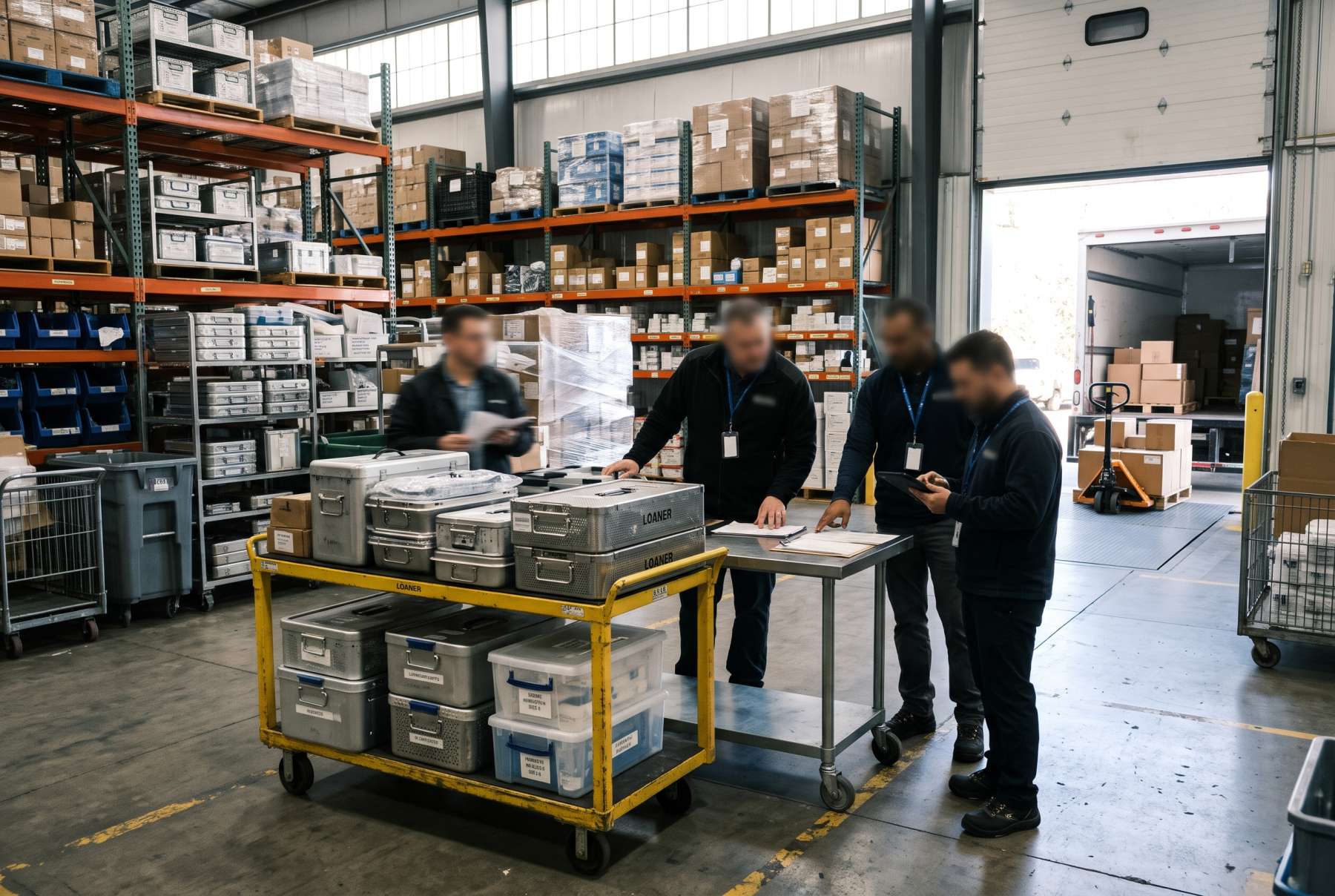
A delayed order may be split across multiple shipments. A field representative may receive one component while another remains at a distribution center. A loaner tray may be redirected to protect a high-priority case and never reach the destination recorded in the original plan. A 3PL may receive a tote without a clean confirmation of which hospital or ASC owns the next handoff. A hospital may see a delivery scan while sterile processing is still waiting for inspection, decontamination, assembly, or sterilization.
That is how a shipment becomes operationally ambiguous. The order exists. The carrier record exists. The invoice may exist. The case team still cannot answer the practical question: can the required set be found and prepared in time?
The FDA's current medical device tracking framework is focused on devices whose failure or loss could create serious health consequences, including certain implantable and life-supporting devices. FDA medical device tracking requirements are not a substitute for day-to-day logistics visibility, but they reinforce an important operating principle: knowing the identity and location of an asset matters after it leaves the manufacturer's dock.
For tray and loaner operations, the same principle applies even when the immediate issue is not a formal regulatory tracking event. A set moving through a warehouse, 3PL, hospital receiving area, sterile processing department, ASC, and field representative's vehicle creates a chain of custody. If the chain is represented only by emails, spreadsheets, and individual memory, a disruption exposes the gaps quickly.
The backlog is not just at the manufacturer
When normal shipping resumes, the receiving network often inherits the harder part of the recovery.
Delayed orders arrive at once. Teams must separate urgent cases from routine replenishment. Duplicate orders may have been placed while the original order was still invisible. Field inventory may be replenished before the representative has reconciled what was already in a hospital or ASC. A distributor may receive sets that were expected at another location. The shipment has technically been recovered, but the network has not yet been reconciled.
This is where a simple status such as shipped or delivered fails. It does not show whether the asset is at the right facility, whether it is complete, whether it is waiting for processing, or whether another team has already claimed it for a different case.
In practice, recovery requires exception reporting. Which trays missed their planned arrival window? Which sets changed destination? Which assets have not produced a receiving confirmation? Which kits were delivered but have not entered the next operational step? Which assets are moving without a case assignment? These are not abstract dashboard questions. They determine whether a coordinator spends the morning resolving a known exception or calling five people to reconstruct the last handoff.
A shared live record is especially important when the same asset crosses organizational boundaries. The manufacturer may own the tray. A 3PL may store it. A distributor may arrange the shipment. A field representative may carry it into the hospital. Sterile processing may control its next release. The OR or ASC may be responsible for the case schedule. Each group sees one part of the journey, but the case depends on the whole journey.
Hansel's platform is built around that operational problem: real-time visibility for surgical trays, loan sets, implant totes, and other critical assets, with the asset record remaining visible as responsibility changes. The point is not to replace a carrier's tracking page or a hospital's clinical release process. It is to give the people coordinating the work one current answer to where the asset is and which team has it.
Recovery needs a custody record, not another phone tree
The most expensive part of a disruption is often not the original delay. It is the uncertainty that follows.
When teams cannot prove the last known location, they compensate with buffer inventory, duplicate shipments, emergency freight, and manual searches. They may send a second tray because the first one is assumed lost, then discover both sets in different parts of the network. They may hold a case open while a field representative checks a vehicle, a receiving dock, or an SPD staging area. They may classify an asset as unavailable even though it is physically present but not yet processed.
None of those responses is irrational. They are what people do when the system cannot distinguish a missing asset from an unconfirmed handoff.
The answer is not to pretend that visibility solves every disruption. A live location does not make a tray complete. It does not approve a device for clinical use. It does not replace the manufacturer's instructions for use or sterile processing controls. It does, however, narrow the operational unknowns. A team can see that the set is at a 3PL, at the hospital dock, inside sterile processing, or moving toward an ASC. It can identify the exception before the case is already late.
That distinction matters in a post-disruption environment. Clinical teams still make the final decisions about whether an asset is suitable and ready for use. Operations teams need enough evidence to get the right asset to the right place and to hand it off with less ambiguity.
The Boston Scientific incident was resolved as a business continuity event, but the operating lesson remains active. Manufacturers will recover systems. Carriers will restore lanes. Distribution centers will clear backlogs. The network downstream still has to prove what moved and what did not.
For tray and loaner operations, readiness should therefore begin one step earlier than the usual question, “Did it ship?” The sharper question is, “Can every responsible team see where it is, who has custody, and what must happen next?” Until that answer is shared, shipping may be back. The operation is still catching up.