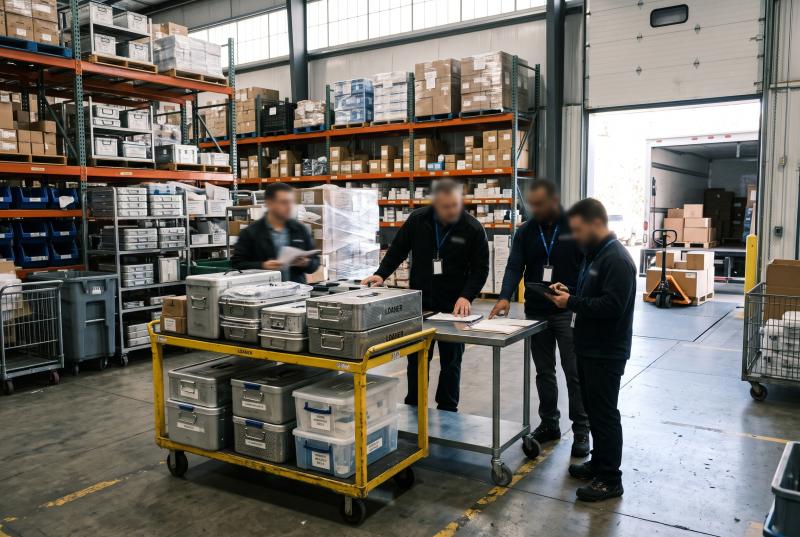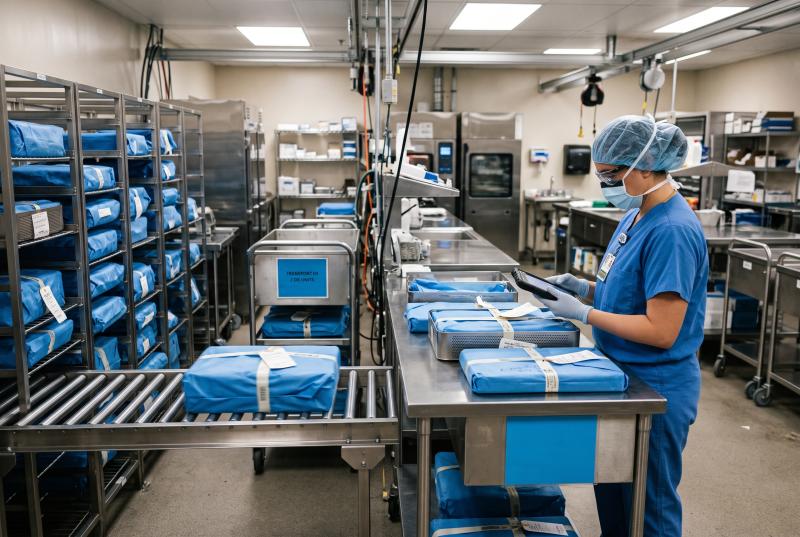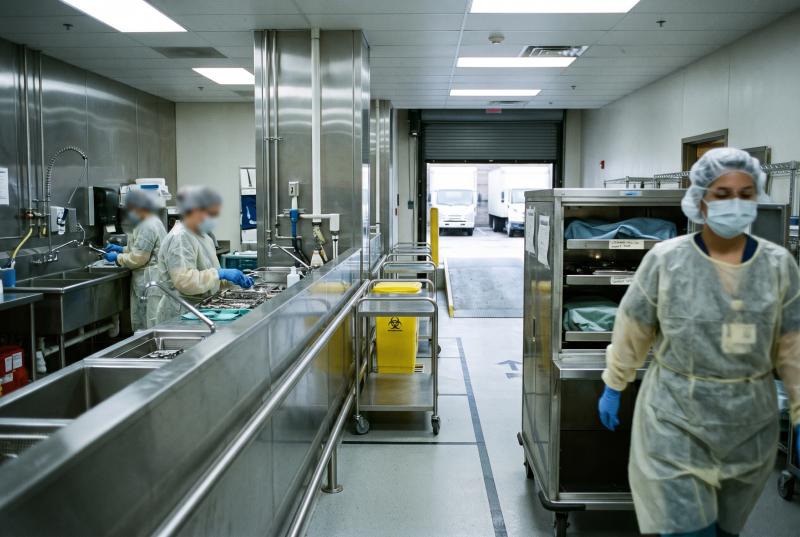
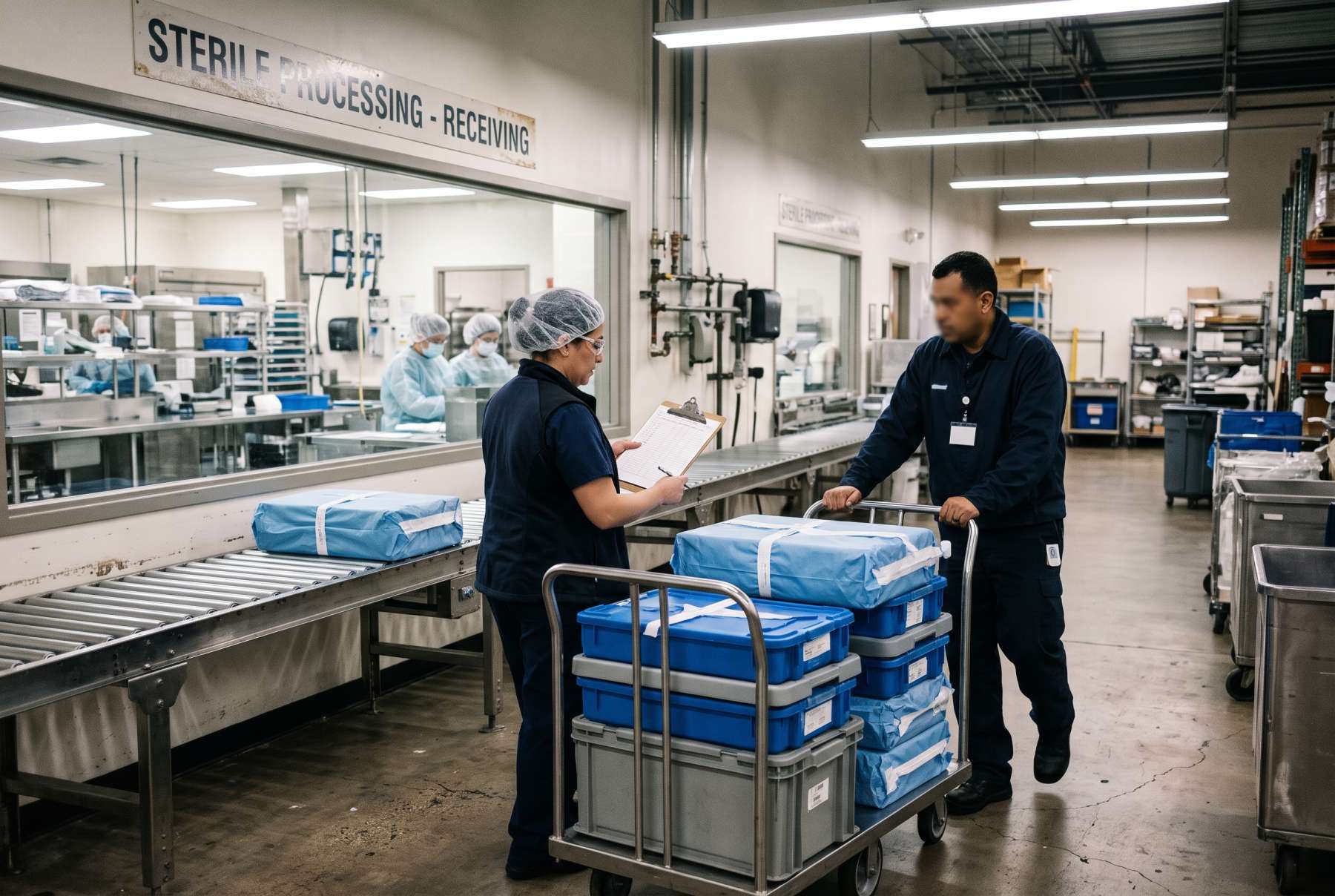
A tray can arrive at an ASC and still be operationally missing.
That sounds contradictory until someone asks the questions that matter after the delivery van leaves: Who accepted it? Was it the correct tray? Was it intact? Did it go to decontamination, storage, the OR, or a staging area? Was it processed for the scheduled case, or did it simply enter the building? If the answers live in a driver’s message, a paper sign-in sheet, and three separate phone calls, the tray has arrived physically but not operationally.
This distinction is becoming harder to ignore. The 2026 AORN instrument cleaning guideline updates put more attention on how contaminated instruments are transported between facilities, including the need for standardized oversight, appropriate packaging, and controls that protect instrument integrity during road transport. That is not just a sterile processing concern. It is a visibility problem shared by the manufacturer, distributor, 3PL, field team, hospital, and ASC.
Arrival is an event. Readiness is a chain.
In a busy device network, people often use “delivered” as shorthand for several different conditions. The shipment was scanned at the warehouse. The carrier says it was delivered. A receiving employee saw a case on the dock. Someone in sterile processing may have moved it later. A field representative may believe the set is ready because the hospital did not call with a problem.
Those are separate events, and treating them as one creates blind spots.
A surgical tray moving from a manufacturer or distributor to a 3PL, then to a hospital or ASC, may cross several custody points before it reaches the process that determines whether it can support a case. The device may be in transit, received, waiting for inspection, in decontamination, assembled, sterilized, staged, or returned. A shipping status rarely explains which of those conditions is true.
The difference matters most when the schedule is tight. An orthopedic case may depend on a loan set that was supposed to arrive the afternoon before surgery. If the set is delayed, the team needs to know whether it is still on a truck, sitting in receiving, waiting for a signature, or already in sterile processing. “We are checking on it” is not a status. It is an admission that the network has lost its shared picture.
The ASC operations discussion published by Becker’s ASC makes a related point from another angle: repeated delays often come from several small failures in ownership, equipment readiness, and communication rather than one dramatic breakdown. The same pattern appears in tray movement. A missing handoff, an unclear receiving location, and an unconfirmed processing step can combine into a case delay even when every individual team believes it completed its part.
The 3PL handoff is not the end of the shipment
For manufacturers and distributors, the temptation is to treat the carrier scan as the clean finish line. For hospitals and ASCs, the temptation is to treat the receiving signature as proof that the work is now internal. Neither view is sufficient for surgical assets.
A 3PL may be responsible for transport, consolidation, or temporary storage, but the asset still has to become visible to the next team. A hospital may receive the container, but the sterile processing department still needs to know what is inside, when it arrived, and what priority it carries. An ASC may have the tray in the building, but the case team needs a reliable answer about whether it is processed and staged for the scheduled procedure.
This is where custody evidence becomes more useful than a simple delivery record. The question is not whether every step needs a new form. The question is whether the people responsible for the next decision can see the last confirmed location and the next expected action.
That shared picture can expose exceptions earlier. A tray that remains at a 3PL beyond its planned departure window is a different problem from a tray that arrived at the hospital but has not entered sterile processing. A tray that was routed to the wrong ASC is different from a tray that is correctly located but missing an instrument. Each exception has a different owner and a different recovery path.
Without that distinction, the field representative becomes the informal tracking system. The rep calls the warehouse. The warehouse calls the carrier. The ASC calls sterile processing. The hospital calls the rep again. Every call adds delay, but none creates a durable record that the next shift can trust.
Visibility supports release decisions. It does not make them.
There is an important boundary here. Asset visibility does not replace clinical release, inspection, decontamination, sterilization, or the manufacturer’s instructions for use. A tray marked as located is not automatically safe to use. A set marked as received is not automatically case-ready.
That boundary is especially important as sterile processing teams manage more complex instruments, loaned devices, and off-site transport. The AORN update notes that organizations using centralized or off-site processing need consistent oversight across the journey. It also points to transportation conditions that can affect instrument integrity before reprocessing begins.
The operational system should therefore answer a narrower and more useful question: where is the asset, what has happened to it, and which team owns the next step?
For a field team, that may mean seeing that a loan set reached the hospital but is still awaiting processing. For sterile processing, it may mean confirming that the expected tray is physically present rather than relying on a shipping email. For an ASC administrator, it may mean knowing that the tray is not merely in the building but has a defined path toward the scheduled case. For a manufacturer or distributor, it may mean separating a carrier failure from a hospital receiving delay before deciding how to recover the case.
Real-time tracking is valuable here because it reduces the distance between an operational change and the people who need to act on it. When the system shows that a tray moved from a warehouse to a hospital, or from receiving into sterile processing, the organization can focus on the exception instead of reconstructing the entire journey through messages and spreadsheets. Tags that remain with the asset through sterilization matter for the same reason. Visibility that disappears at decontamination is not continuous visibility.
The better question is: ready for what?
Many organizations use “ready” as though it were a single status. In practice, readiness has layers.
- Transport-ready: the asset is packed, assigned, and moving to the intended destination.
- Received: the destination has confirmed physical possession and can identify the asset.
- Processing-ready: the set is available for the next sterile processing step and any exception is visible.
- Case-ready: the responsible clinical and processing teams have completed their own requirements for use.
Those labels should not be confused, but they should be connected. A manufacturer may need to know whether the kit is still in transit. A distributor may need to know whether a return actually reached the warehouse. A 3PL may need evidence that the handoff occurred at the right location. The hospital may need to know whether the tray entered processing. The ASC may need to know whether the scheduled case has a viable set, not merely a tracking number.
That is the practical lesson in the current transport conversation. Better controls do not come from asking every team to make more calls. They come from making the asset’s state visible enough that each team can perform its own job without guessing what the previous team did.
When a tray is delayed, the goal is not to create a perfect retrospective. The goal is to identify the break while there is still time to recover. When a tray is recalled or corrected, the goal is not only to produce a list of affected assets. It is to know which ones are at a 3PL, which are at a hospital, which are in sterile processing, and which may already be moving toward a case.
The tray that arrived is not necessarily the tray that is ready. The difference is the chain between custody, location, processing, and action. If that chain cannot be seen, the organization is not managing readiness. It is inferring it.