The most dangerous phrase in a sterile processing conversation is often not “missing tray.” It is “we know where it is.”
A tray can be sitting in a distributor warehouse, a hospital storage room, a third party sterile processing facility, or a field representative’s vehicle and still be unusable for the next case. The physical location answers one question. It does not answer whether the set was processed under the current instructions, whether it has been quarantined, whether it is assigned to a case, or whether somebody has confirmed that the correction reached the people handling it.
A recent FDA entry makes that distinction concrete. On October 15, 2026, the FDA posted a Class 2 correction involving 577 TS Miscellaneous Instruments Trays used with the Triathlon system. The correction affected catalog number 6543-6-519 and lots used before May 8, 2026. The issue was not a missing component or a broken instrument. The problem was that the instructions specified a 30 minute sterilization dry time for trays in blue wrap, while the corrected instructions require 40 minutes.
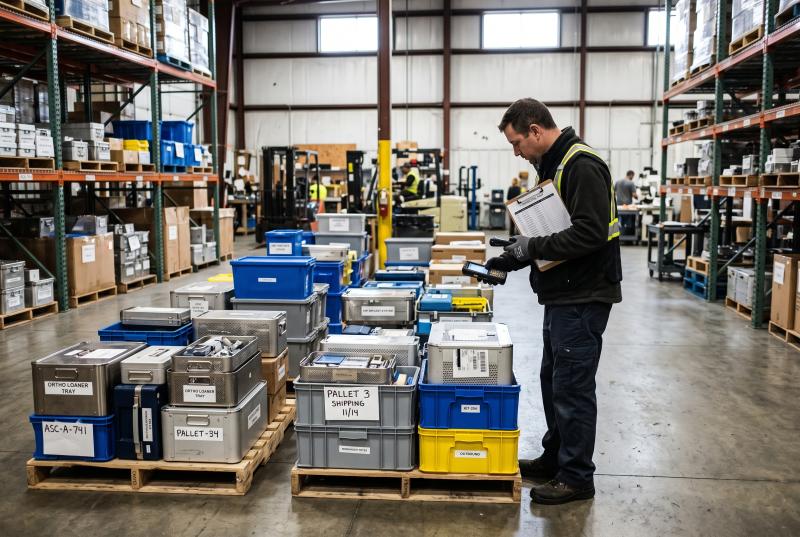
The FDA record says the trays were distributed by sale or loan, with loans provided through distributors. That detail matters. A correction like this does not stop at the manufacturer’s quality department. It moves through a network of distributors, 3PLs, hospitals, ASCs, sterile processing departments, operating rooms, and field teams. The operational question is not only who received the notice. It is which physical trays are affected, where they are now, what status they carry, and what case plans depend on them.
A correction changes the meaning of “available”
Most inventory conversations still treat availability as a location problem. A tray is either in the warehouse, at the hospital, in transit, or out with a rep. That is useful, but incomplete. In a correction involving reprocessing instructions, availability becomes conditional.
The affected tray may be physically present and still require action before it can be used. It may be wrapped and waiting for a case, but processed under the old dry time. It may be sitting in a sterile storage area with no obvious visual difference from a compliant tray. It may have moved through several facilities since the manufacturer’s notice was issued. It may be scheduled for a procedure tomorrow even though nobody has recorded whether the updated instructions were applied.
That is why a spreadsheet export or a morning barcode walk can create false confidence. The record may say the tray is at Hospital A. The surgical schedule may say it is needed for a total knee case. The field rep may believe it was returned to the distributor. The sterile processing department may have placed it on hold. All four statements can be true at different moments, and none of them alone describes case readiness.
The FDA correction is a labeling and processing issue, not a reason to assume that every affected tray is unsafe or unusable. The point is more practical: when the handling instruction changes, the asset record needs a way to carry that change. Location, ownership, processing status, and case assignment have to remain connected to the physical set.
The hard part is the handoff after the notice
Device corrections expose the weak points between organizations. Manufacturers may communicate quickly to direct customers. Distributors may have their own inventory systems. Hospitals may manage loaner trays through sterile processing policies and local sign in sheets. 3PLs may control transportation and staging. Field representatives may be the people who know which case the tray is intended to support.
Each group can perform its piece of the response and still leave a gap in the shared picture.
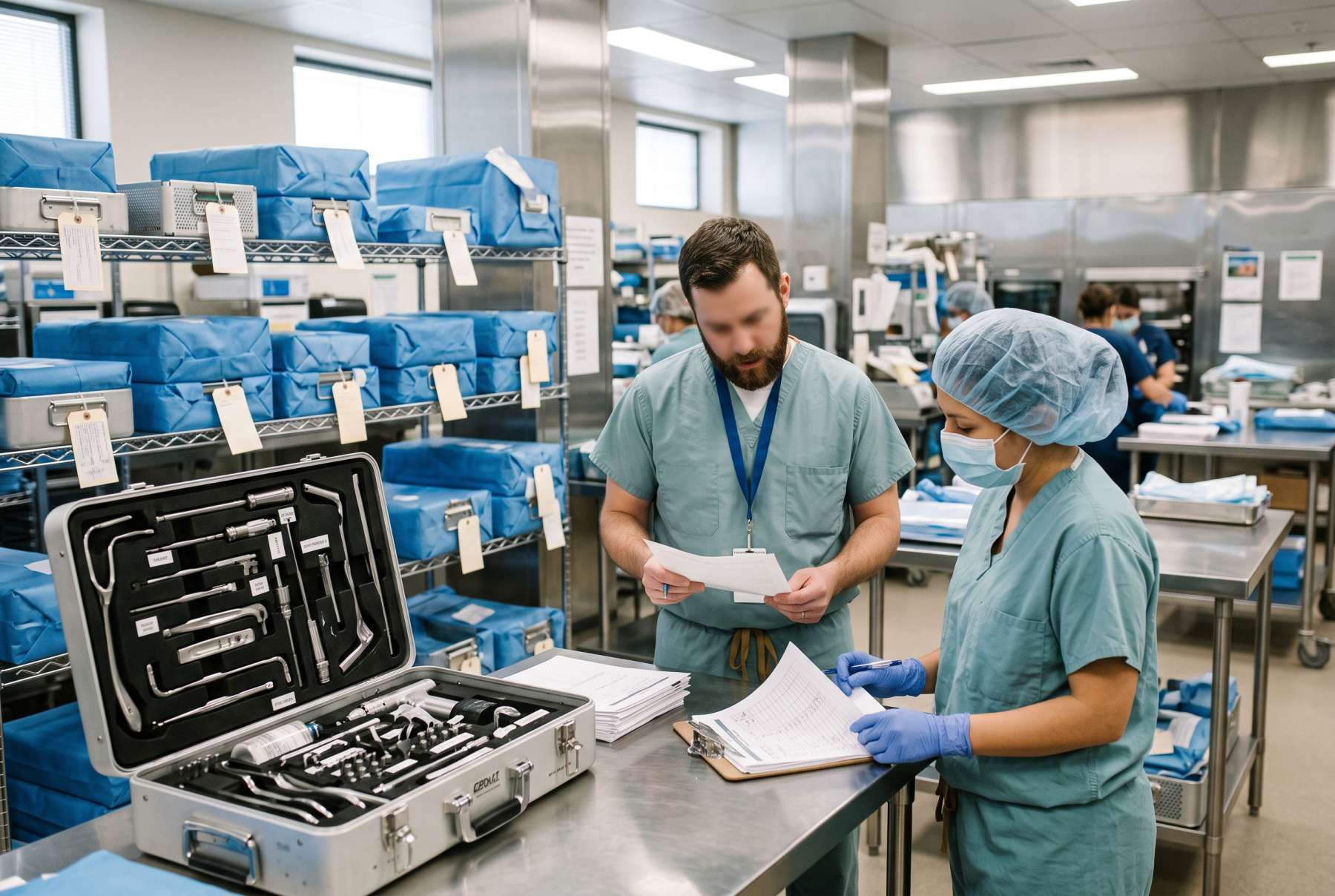
The AORN sample policy for loaned instrumentation reflects the operational burden. Loaner instruments are expected to be received, inspected, recorded, decontaminated, and sterilized. The policy also calls for manufacturer instructions, tray content lists, and identification of the procedure and timing associated with the set. That workflow assumes the team can identify the tray, connect it to the right documentation, and know where it is in the process.
In practice, the handoff often becomes a chain of phone calls. A distributor asks whether a hospital has the set. The hospital asks sterile processing whether it has been run. The field rep checks a case email. Someone searches a storage room for a label or lot number. Meanwhile, the tray remains attached to a case date that does not move with the physical asset.
The problem is not that people are careless. It is that the network uses different definitions of status. “At the hospital” can mean received at the loading dock, in the loaner cage, in decontamination, wrapped in sterile storage, or already opened for the procedure. “Returned” can mean the case is over, the tray is packed, the courier has picked it up, or the distributor has checked it back into inventory.
A correction forces those ambiguities into the open. If the tray is affected, the response depends on more than finding it. Someone must know whether it was used, whether it was processed under the old instruction, whether it is being held, and whether a replacement or revised processing step is needed before the case can proceed.
Visibility has to survive sterile processing
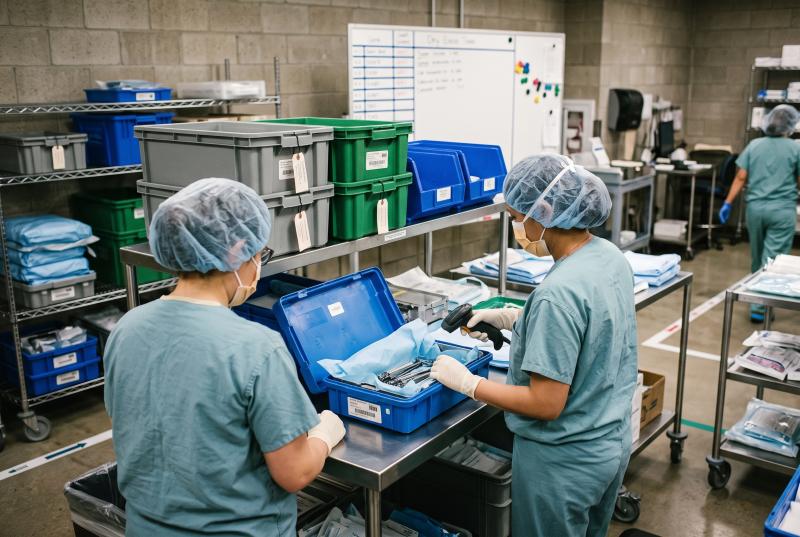
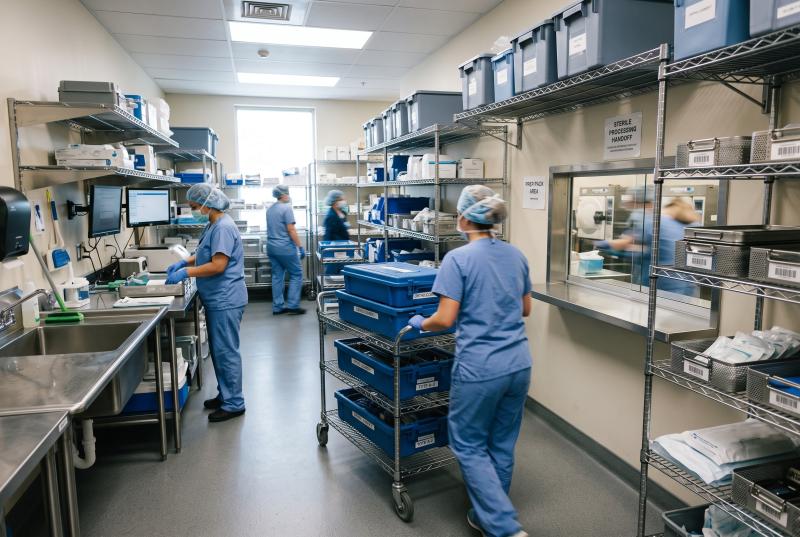
Location tracking is most valuable when the asset crosses the part of the workflow where manual visibility tends to disappear. For surgical trays, that is often decontamination, sterilization, storage, and transport between the distributor, hospital, ASC, and 3PL.
A barcode scan can document a handoff, but it depends on the next person scanning at the right time. A phone tree can find an answer, but only after someone knows which question to ask. A spreadsheet can show what was expected, but it rarely shows what changed after the tray entered processing.
Continuous visibility changes the starting point. Instead of asking which person last touched the tray, operations teams can begin with the asset and its current location. From there, they can attach the operational context that matters: whether the set is moving, waiting, assigned, held, or ready for a case.
That distinction is especially important for loaner inventory. The Association of periOperative Registered Nurses notes that loaner instruments must be processed before use and that teams should follow the manufacturer’s instructions for cleaning and sterilization. It also warns against using immediate use steam sterilization to compensate for inadequate inventory or late delivery. If a tray arrives too late, the consequence is not simply an inconvenient shipment. It can become a processing decision with clinical and operational implications.
For a distributor or 3PL, the useful question is not only how many trays are in the network. It is how many are truly deployable for the next 24, 48, or 72 hours. That number should account for location, processing status, case assignment, and any quality hold. A set in transit to a hospital is not equivalent to a set in sterile storage. A set in decontamination is not equivalent to a set cleared for a morning case. A set with an outdated processing instruction is not equivalent to a compliant set simply because its label matches the expected catalog number.
The operational metric is time to certainty
Teams often measure recall and correction response by how fast a notice was distributed. That is important, but the field measure is different: how long did it take to establish the status of every affected asset?
That clock starts when the manufacturer or distributor identifies the affected population. It ends when each tray has a known location, a known processing condition, a clear disposition, and an owner for the next action. A tray that cannot be located is one problem. A tray that can be located but has an unknown processing history is another. A tray that is correctly processed but not released from hold is a third.
Those distinctions help teams prioritize. The tray assigned to tomorrow morning’s case deserves a different response from the tray sitting in long term storage. The tray in a 3PL staging area may need a different action from the tray already at an ASC. The tray that passed through decontamination before the corrected instruction was received may require documentation that a tray still sealed in a distributor warehouse does not.
The better operating model is not more urgent calls. It is a shared asset record that follows the tray through the network and makes uncertainty visible. When the status is clear, the field rep can work from the same information as the sterile processing lead. The distributor can see which sets are held instead of promising inventory that is not actually deployable. The ASC can identify a case risk before the patient is in the room.
A device correction involving 577 trays may look narrow on paper. On the dock, it is a test of whether the organization can distinguish “somewhere in the network” from “ready for this case.” The first is a location statement. The second is an operational decision.
For medical device operations, that is the sharper standard. Do not ask only whether the tray can be found. Ask whether the network can prove what happens next.