
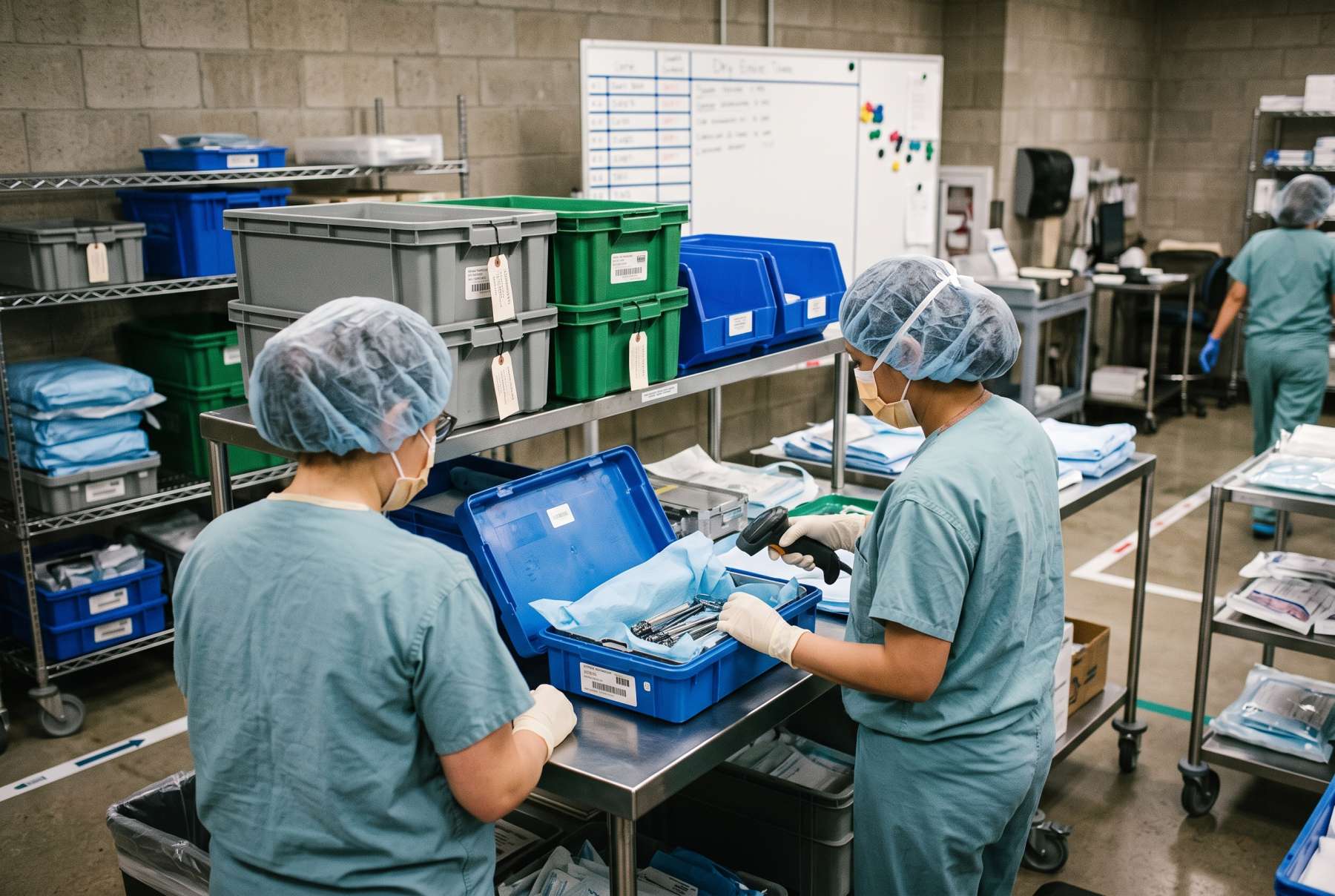
The next pressure point for ASC supply chains may not be a shortage, a recall, or a new procedure list. It may be the tray that comes back one day late.
On July 2, 2026, the Centers for Medicare and Medicaid Services proposed a 2.4% update to ASC payment rates for calendar year 2027. The proposal also continues the phase-out of the inpatient-only list, with 638 services proposed for removal in the second year of that transition. CMS said the proposed changes would affect approximately 6,400 ASCs and give physicians more flexibility to perform additional procedures in outpatient settings. The proposal is not a final rule, but the operating direction is clear: more work is being pushed toward outpatient facilities while the payment model continues to reward throughput and cost control.
That makes the return cycle for surgical trays more than a logistics detail. A late set can reduce a center's ability to accept the next case, force a replacement shipment, keep a field representative on the road, or leave a manufacturer carrying more inventory than its utilization supports. When margins are tight, the question is not simply whether the tray exists. The question is whether it will be physically available, processed, assigned, and ready when the schedule requires it.
Payment pressure changes the definition of available
ASC operators have always cared about case time. What is changing is the number of operational variables that must line up for each case to remain financially sensible. A center can have a surgeon, a room, a patient, and a procedure code on the schedule and still lack the correct instrument set at the moment it is needed.
That gap is easy to miss because most inventory conversations collapse several different conditions into one word: available. A tray may be in a hospital loading dock but not yet returned to the manufacturer. It may be in a 3PL warehouse but not inspected. It may have arrived at an ASC but still be in decontamination. It may be clean but assigned to another case in the same network. Each condition creates a different operational decision, but a spreadsheet often records only a location or a last-known status.
The CMS proposal puts more weight on the ability to make those distinctions quickly. If a procedure moves from the hospital to an ASC, the asset network supporting that case usually becomes less forgiving. There may be fewer backup sets, shorter room turnover windows, and less storage on site. A hospital can sometimes absorb a late tray by shifting inventory between rooms or drawing on a larger central supply operation. An ASC often has fewer alternatives.
CMS also issued an October 2026 update to the ASC payment system, effective October 5, with revised codes and payment information. That kind of routine update is not itself a tray-management mandate. It is a reminder of how frequently outpatient operations must absorb changes while maintaining the same basic promise: the right case can start with the right equipment. The cost of a missed handoff does not appear as a separate line item on the payment file, but it shows up in overtime, courier fees, unused room time, and lost confidence in the schedule. CMS's 2027 OPPS and ASC proposed rule fact sheet and the October 2026 ASC payment update provide the policy context for that operating environment.
A late return is not one problem
When an instrument set misses its expected return date, teams often respond as if the only issue is transportation. Someone calls the rep. The rep calls the warehouse. The warehouse checks a carrier portal. The ASC checks its loading dock. Sterile processing checks whether the tray was washed, wrapped, or held for an instrument discrepancy.
Those calls may eventually locate the set, but they do not answer the more useful question: what decision should happen next?
If the tray is still at the previous hospital, the network may need to change the route or request a recovery pickup. If it is already at the manufacturer but waiting for inspection, the case assignment may need to move to another set. If it is inside an ASC's sterile processing department, the issue is not transportation at all. It is processing capacity and priority. If the set is clean but not assigned, the problem is planning. If it is assigned to a case that moved dates, the problem is stale scheduling data.
These distinctions matter because the remedies are different. A faster courier cannot solve a tray that is waiting for decontamination. A new purchase cannot solve a set that is sitting unused at another facility. A phone tree cannot reliably identify which kit should be redirected when several cases compete for the same asset.
The practical standard should be a service level tied to the case, not an informal promise that a tray will be sent back soon. For example, a network might define when a loan set must leave the ASC after a procedure, when the receiving warehouse must acknowledge it, how long inspection may take, and when an exception becomes a routing decision. The exact thresholds will differ by procedure and asset class. A high-volume arthroscopy set, a complex spine set, and an implant tote should not necessarily follow the same return rule.
What they should share is a visible chain of responsibility. The manufacturer needs to know the last confirmed location. The 3PL needs to know whether the asset is moving or stalled. The field team needs to know whether the set is actually ready for the next case. The ASC needs to know whether it can commit the asset without sending another round of messages.
The useful metric is not turns alone
Utilization reporting is often reduced to how many times a tray was used during a month. That is helpful, but it is incomplete. A set that moved frequently may be productive, or it may be generating avoidable courier expense and emergency handling because it is being routed without enough recovery time.
For ASC networks, a stronger view combines movement, availability, readiness, and service performance. Questions worth asking include:
- How often was a tray assigned to a case but not ready by the required date?
- How long did the asset remain in a processing or exception state?
- How many cases depended on the same set across different facilities?
- How often did a late return trigger a replacement shipment?
- Which assets were physically present but unavailable because their status was unclear?
- Where did the network hold extra inventory because no one trusted the return data?
Those questions move the discussion away from a simplistic owned-versus-loaner debate. The relevant cost is not only the purchase price of another tray. It is the cost of uncertainty around the trays already in circulation.
A live asset picture changes the operating conversation. When a tray's location updates automatically through warehouse, hospital, ASC, and sterile processing environments, teams can separate a transportation delay from a processing delay. When case requirements and inventory readiness are visible together, a scheduler can identify risk before the first case of the day. When utilization is tied to actual movement and availability, operations leaders can see whether an additional set would solve a capacity problem or merely hide a routing problem.
That is where tracking earns its place in the budget. Not because every tray needs a dashboard, but because outpatient growth makes the cost of guessing harder to absorb. Hansel's model is built around real-time visibility for surgical trays, loan sets, implant totes, and related inventory, including tags designed to remain with the asset through sterilization. The operational value is straightforward: fewer calls asking where a set went, fewer decisions based on stale scans, and more time to act before an unavailable tray becomes a canceled or delayed case.
The 2027 ASC payment proposal may eventually change rates and procedure eligibility. The more immediate change is managerial. As more cases move into facilities with tighter space, shorter windows, and less backup inventory, every late return becomes a test of whether the network understands its own assets.
The tray does not need to be lost to create a margin problem. It only needs to be somewhere the next team cannot confidently see, process, assign, or route.