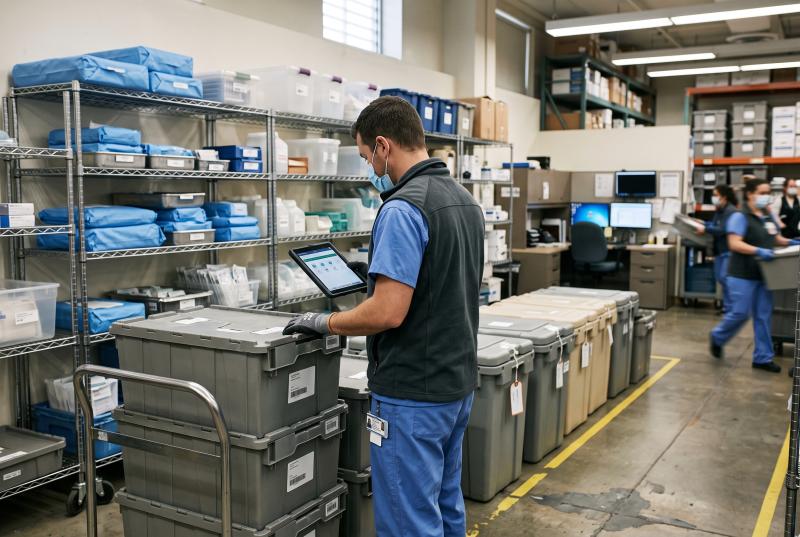

The next bottleneck in ambulatory surgery may not be another operating room, another surgeon, or another block of scheduled cases. It may be the tray that technically belongs to the network but cannot be found, confirmed, or released in time.
That distinction matters as outpatient surgery keeps expanding. In its July 2, 2026 proposed rule for calendar year 2027, the Centers for Medicare and Medicaid Services proposed a 2.4% update to ASC payment rates and continued the phase-out of the inpatient-only list by proposing to remove 638 services from it. The policy direction is clear: more procedures can move into outpatient settings when the clinical and operational conditions support it. CMS's CY 2027 OPPS and ASC proposed rule lays out that direction. (cms.gov)
But adding outpatient capacity changes the tray problem. A hospital may have enough sets in the enterprise and still be unable to support the next case at an ASC. The missing variable is not ownership. It is movement.
More sites turn inventory into a network problem
A single hospital can sometimes absorb weak visibility through local knowledge. The SPD manager knows which rack is usually full. The loaner coordinator knows which rep tends to keep a set in a vehicle. The circulating nurse remembers that a tray came back from another campus late last week. Those workarounds are fragile, but they can function when the physical network is small.
ASC growth removes that margin. A health system may be coordinating a central warehouse, several acute-care hospitals, freestanding ASCs, physician-owned facilities, manufacturer loaner sets, distributor inventory, and third-party logistics locations. The same orthopedic tray can move through several of those sites before it is ready for a case.
That means “we have 12 sets” is no longer a useful operational answer. The better questions are more specific:
- How many sets are physically at the site where the case will occur?
- How many are in transit or sitting at another facility?
- How many are inside sterile processing?
- How many have completed the required processing cycle?
- How many are already assigned to another case?
- How long has each set been idle, moving, or unaccounted for?
Those questions are not a request for more reporting after the fact. They are a request for the operating picture to match the physical network.
The pressure is showing up in the way health systems are thinking about ambulatory growth. A July 2026 Becker's Hospital Review analysis described ambulatory shifts as reshaping perioperative strategy around capacity, staffing, physician alignment, and growth. A separate report on Lee Health framed OR access as an enterprise asset and focused on using existing capacity better rather than assuming the answer was simply to add more. Becker's coverage of ambulatory perioperative strategy and its report on Lee Health's access strategy point to the same operational tension. (beckershospitalreview.com)
Utilization is not a spreadsheet percentage
When leaders ask for tray utilization, they often receive a percentage built from whatever data is easiest to collect. A set was assigned to a case, so it counted as used. A kit was not checked back in, so it appeared unavailable. A manual count found it in a warehouse, so it appeared on hand. None of those answers necessarily describes how the asset is functioning in the network.
Utilization has at least three operational layers.
The first is demand. How often is a procedure scheduled that requires the tray or loaner set?
The second is movement. How often does the asset travel between warehouse, hospital, ASC, sterile processing, and the field? A set that moves constantly may be highly needed, but it may also be consuming staff time and creating avoidable handoff risk.
The third is readiness. Was the tray processed, complete, and available before the case? A kit that arrives after the scheduled start may show strong activity in a report while still failing the case.
This is why a utilization dashboard built only from case assignments can mislead. It can show that an asset is busy without showing whether the network is using it efficiently. The operational question is not merely whether a tray moved. It is whether the movement supported a case without creating another search, another rush shipment, or another duplicate set held “just in case.”
For a distributor or manufacturer, the same issue appears from the other side. A loaner set may be described as available because it is not currently assigned. In reality, it may be in an unknown location, waiting for decontamination, incomplete after a prior procedure, or sitting at a site with no upcoming case. Availability without location and status is a guess.
That is where reporting needs to come from the live operational record. Utilization, movement, case activity, and autoclave activity should be connected to the same asset history rather than reconciled later across separate spreadsheets. Otherwise the report describes an inventory universe that changed as soon as the last manual update ended.
The useful metric is time between decisions
For field teams, the practical value of visibility is not a prettier map. It is the time saved between an operational question and a defensible answer.
When a coordinator asks where a tray is, the answer should not depend on calling three people. When an ASC adds a case, the team should be able to see whether the required set is nearby, already committed, still in processing, or moving from another site. When a loaner arrives, the record should not remain blind simply because the tag passed through decontamination or sterilization.
An autoclavable tag that stays with the asset through those handoffs changes the quality of the data. Beacons and gateways can report presence without asking a staff member to stop and scan every movement. The platform can show the last reliable sighting, the relevant site in the location hierarchy, how long the asset has been there, and when it was last seen. If there is no site associated with the last sighting, the operational answer is that the asset is in transit, not that someone should invent a street-level location.
That detail matters in a growing ASC network. The right decision may be to move a set from a central warehouse, release one from a nearby hospital, request a manufacturer loaner, or change the case sequence. Those decisions are different, but they all require the same starting point: an accurate view of where the asset is and what has happened to it.
The system also needs to preserve the difference between location and readiness. A tray can be at the ASC and still be inside sterile processing. It can be at the hospital and still be assigned to another procedure. It can be visible in the warehouse and still be missing an instrument. Location is necessary, but it is not the whole case-readiness decision.
Capacity only counts when the network can use it
The temptation during ASC expansion is to measure capacity by acquisition: more facilities, more cases, more sets, more vendor relationships. The harder measure is usable capacity. How much of the existing tray network can the organization confidently deploy without hunting, duplicating, or holding excess inventory against uncertainty?
That is why utilization reporting should be treated as an operating discipline rather than a finance appendix. It can show which trays are genuinely scarce, which are trapped in long dwell times, which sites are borrowing repeatedly, and which assets are moving enough to justify a different distribution model. It can also show when the network owns enough physical inventory but lacks enough visibility to use it.
CMS's proposed 2027 policies are not a tray-tracking mandate. They do, however, reinforce the direction of travel toward more outpatient volume and more pressure to make each site work. For hospitals, ASCs, manufacturers, distributors, and 3PLs, that makes the basic question sharper.
Do not ask only how many trays the network owns. Ask how many can be located, processed, assigned, and ready when the case needs them. In an expanding outpatient system, that is the difference between capacity on paper and capacity the operating room can actually use.