"On hand" used to sound like a reassuring answer. A distributor had inventory. A hospital had a kit. A 3PL had a tote assigned to an account. The item existed somewhere in the network, so the case was considered covered.
That definition is getting harder to defend. The FDA's current medical device shortage list includes devices affected by manufacturing disruptions, component problems, allocation, and permanent discontinuances. Some shortages are expected to continue into the fourth quarter of 2026 or the first quarter of 2027. In a shortage, the question is no longer simply whether an organization bought enough. It is whether the right usable item is in the right place, with the right contents, before the case needs it.
That is a different operational problem. It starts with procurement, but it quickly becomes a visibility problem across warehouses, hospitals, ASCs, sterile processing, field teams, and procedure schedules.
Shortage guidance assumes more than a purchasing record
In May 2026, the FDA warned that a disruption affecting neurosurgical patties, sponges, and strips could impact patient care through the end of the year. The agency recommended conservation, prioritization of essential cases, centralized storage and distribution, daily usage monitoring, and careful management of procedure kits containing the affected devices. The guidance is practical, but each recommendation depends on an operational fact that many organizations do not have in one place: where the inventory is and what is inside the kit.
A purchasing system can show that 40 units were received. An ERP can show that 12 were allocated to a hospital. A spreadsheet can show that a loaner tray was expected back from an ASC. None of those records necessarily answers whether the units are still in the warehouse, sitting in a hospital's sterile processing department, packed inside a surgical kit, waiting for inspection, or moving between sites.
The same problem appears when an organization tries to conserve a scarce device. Conservation is not only a policy decision. It is a movement decision. Teams need to know which site has stock, which case is using it, which kits contain it, and whether an alternative kit is actually ready. Otherwise, staff protect inventory in one location while another team orders more because it cannot see what is already available.
The FDA's Medical Device Shortages List is designed to provide public visibility into shortage conditions. It is not an inventory system for a hospital, distributor, manufacturer, or 3PL. The industry still needs its own live picture of the assets and kits affected by the shortage.
The kit may be available while the case is not
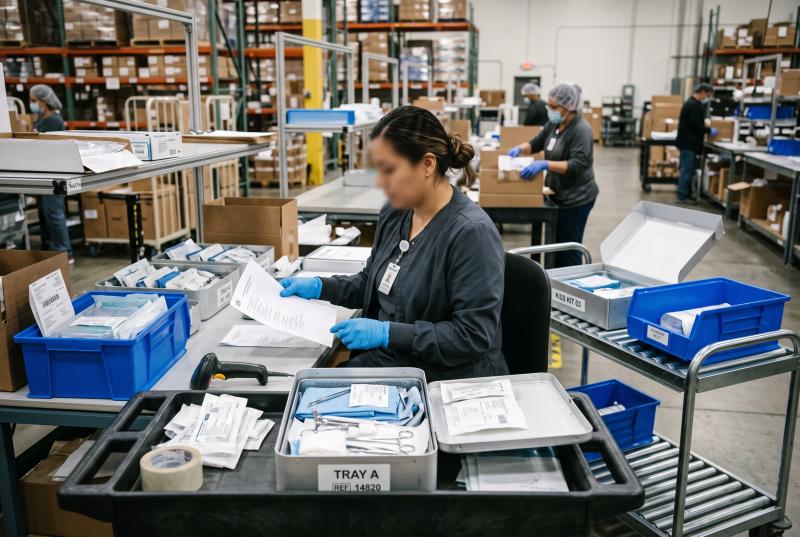
Shortage operations become especially difficult when the affected item travels as part of a reusable tray or loan set. The organization may report that the kit is available, but availability can mean several different things.
- The tray is physically at the expected facility.
- The tray has cleared decontamination and sterilization.
- The required components are still inside the tray.
- The kit is assigned to the correct case or procedure.
- The contents are usable under the current shortage or conservation plan.
Those are not interchangeable statements. A kit can be at the hospital and still be in decontamination. It can be sterile and missing the one component that matters for a particular procedure. It can be complete but assigned to tomorrow's case at another site. It can be physically present but not yet reconciled after a partial use.
This is why shortage response often produces a strange kind of inventory inflation. The network appears to have enough assets when counted at a high level, but the number of case-ready options is much smaller. The gap is not necessarily caused by theft, waste, or poor planning. It is caused by counting possession instead of readiness.
For a field representative, that gap creates calls that sound simple but are not. Is the kit at the hospital? Has it been opened? Did the affected component come back? Is the substitute item in the tote or in another tray? Can the set be used for this procedure, or is it being held for a higher-priority case?
A live asset record does not solve the clinical judgment involved in substitutions or conservation. It does make the physical and operational facts easier to establish. An autoclavable tag that stays with the tray through decontamination and sterilization can keep location visibility alive at the exact point where manual barcode workflows often stop. The team can see the last reliable sighting, the site hierarchy, how long the asset has been there, and whether it has moved into transit.
That is a modest distinction on a normal day. During a shortage, it can determine whether the next action is to transfer an existing kit, release a reserved asset, confirm contents, or place another order.
Scheduling has to work from exceptions, not assumptions
The final failure point is the procedure schedule. A case calendar may show that a procedure is booked and that the required tray was assigned. It does not necessarily show whether the case is exposed to a shortage exception.
When supply is constrained, the schedule needs an operational layer. Which cases require the affected device? Which cases can use an approved alternative? Which kits are complete? Which assets are still in transit? Which site has enough stock to support the highest-priority case? If those questions live in separate spreadsheets, text messages, and calls, the schedule becomes a list of intentions rather than a readiness picture.
This does not mean the scheduling team should become responsible for every inventory decision. It means the schedule should be connected to the facts that determine whether a case can run. A shared operations calendar can place the procedure, location, required tray, and readiness status in the same view. Worklists can separate cases that are confirmed from cases waiting on a missing item or a contents check.
That distinction also matters outside the hospital. A manufacturer may have loan sets distributed across several IDNs. A 3PL may be holding kits for multiple accounts. A field team may be covering cases at different ASCs on the same day. When a shortage changes priorities, the network needs to see not just inventory totals but movable capacity.
The FDA's supply chain recommendations ask organizations to identify multiple delivery locations, plan alternate routing, prepare communication plans, and track supplies when normal methods are disrupted. Those recommendations apply to emergencies, but the operating principle is broader. If the team cannot establish where an asset was last seen and who has custody of it, the organization is managing a shortage through memory and escalation.
Recent hospital scheduling work has made the same point from another direction. A 2026 Becker's Hospital Review case study described a community hospital clearing a surgical backlog after addressing fragmented scheduling, manual workflows, and poor communication across facilities. The lesson is not that every hospital needs the same intervention. It is that case volume and case readiness are separate operating problems. Improving the calendar does not help if the physical resources behind the calendar remain uncertain.
The better question is case-ready capacity
Shortages expose the weakness in the phrase "we have it." A more useful question is: how many verified, usable, movable kits can support the next set of cases?
Answering that question requires three views working together. The first is location: where is the tray, tote, or loan set now? The second is condition and contents: what is inside, what is missing, and what has happened since the last use? The third is demand: which scheduled cases need the asset, and when?
That is the operational picture procurement records cannot provide on their own. It helps teams conserve without hoarding, transfer without hunting, and escalate an actual shortage instead of a visibility gap.
The most expensive shortage may not be the one with zero units in the country. It may be the one where a usable kit exists inside the network, but nobody can prove where it is or whether it is ready. In that environment, "on hand" is not a supply answer. It is only the beginning of the investigation.