
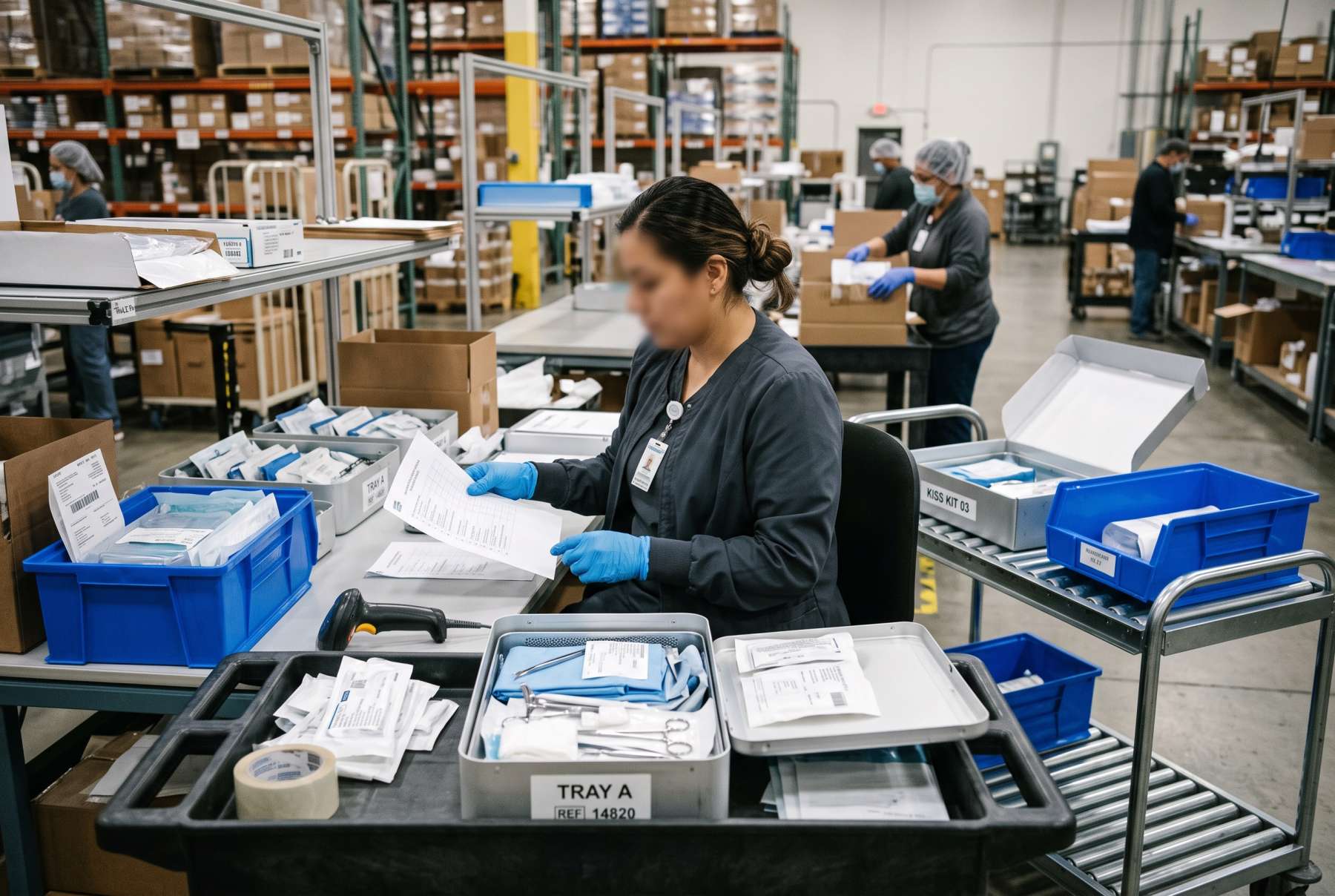
A procedure tray can be physically present, correctly labeled, and still fail the most important readiness question: can the team use everything inside it for the scheduled case?
That distinction became concrete on September 24, 2026, when the FDA updated its notice on BD convenience kits and procedure trays containing recalled sodium chloride ampules. The affected ampule was the only impacted component. The remaining contents could continue to be used, but customers were told to check stock, quarantine affected kits until over-labels were provided, arrange an alternative sodium chloride source, and remove and destroy the affected ampule at the point of use.
That is not the same operational problem as finding a missing tray. It is harder in one important way. The kit may be sitting in the right hospital, in the right department, on the right shelf, while its usable status remains unresolved.
Location answers only half the recall question
Most asset processes are built around the container. A tray, tote, or convenience kit receives a stock number, a destination, and sometimes a scan at each handoff. That model works reasonably well when the entire unit is either available or unavailable.
Component-level corrections break that assumption. The container remains identifiable, but the decision about whether it can move forward depends on what is inside, which lot was included, whether the affected component has been removed, and whether the correction was documented. A location record can tell an operator that the kit is at an ASC. It cannot, by itself, prove that the kit is cleared for the next case.
The FDA notice is explicit that the BD kits and procedure trays should be quarantined until the required labeling is available. It also says the remaining components may continue to be used after the affected ampule is handled correctly. That creates at least three operational states that are easy to flatten into one inventory number:
- The kit is present but not yet reviewed.
- The kit is affected and held pending correction.
- The kit has been corrected and is ready, with the affected component removed or controlled.
A spreadsheet that says “on hand” does not distinguish those states. A barcode scan at the outer package may not distinguish them either. The problem is not that staff lack discipline. The problem is that the record is tracking the container while the decision is being made at the component level.
This pattern is not limited to the BD notice. FDA recall records posted in September also covered convenience kits containing recalled applicators, wipes, and other components. In one September 23, 2026 recall entry, affected kits were to be quarantined, the impacted applicator discontinued, and warning labels added. In the BD tray correction, the action was more targeted, but the operational burden was similar: identify the right kits, prevent unintended use, correct them, and preserve evidence that the correction occurred.
The hard part is the handoff, not the notice
Manufacturers and distributors usually know how to issue a field correction. Hospitals and ASCs usually know how to quarantine product. The weak point is the space between those actions, where a kit may have changed hands several times since it was packed.
A convenience kit can move from a manufacturer or contract packager to a distributor, then to a health system warehouse, then to a hospital or ASC. It may be assigned to a procedure, placed on a cart, returned to storage, or redirected to another site. If the affected component is discovered after the kit has moved, every handoff becomes a question: where is the kit now, who has custody, has it been opened, and was the correction completed?
Phone trees and email searches are particularly weak here because they follow people rather than assets. The field representative may know the kit was delivered. The warehouse may know it left. The hospital may know it was received. None of those facts proves where it is today or whether its status changed after receipt.
The useful operational record has to join the asset, the site, the movement history, and the exception. That means a team should be able to see more than “kit 1842 at Hospital A.” It should be able to see that the kit arrived, was placed on hold, was reviewed, had a component removed or relabeled, and was either returned to ready status or diverted from the case.
For trays and loan sets, that chain is especially important because the same physical asset may pass through a warehouse, a hospital, sterile processing, a procedure room, and a return lane. An autoclavable tag that remains with the asset through sterilization helps preserve location continuity when the tray moves through the part of the workflow where ordinary barcode visibility often disappears. That does not replace component inspection. It makes the inspection actionable because the team can find the asset that needs it.
Case readiness needs a component exception layer
The scheduling consequence is easy to underestimate. A procedure may still appear fully covered because the required tray is assigned to the case. But assignment is not readiness when one component is quarantined, missing, expired, or awaiting correction.
That is why a useful case-readiness process needs two linked views. The first asks, “Where is the kit?” The second asks, “What is its current usable status?” The first is an asset-tracking question. The second is an inventory and workflow question.
In practice, teams need a short exception path:
- Identify affected assets by kit, tray, lot, or component relationship.
- Locate each asset across warehouse, hospital, ASC, sterile processing, or transit.
- Place affected assets into a visible hold state instead of leaving them as ordinary on-hand inventory.
- Record the correction, replacement, removal, or disposition at the point of work.
- Recheck the scheduled case only after the asset returns to a usable state.
The goal is not to turn every recall into a large manual project. It is to avoid treating every affected kit as a total loss when the notice permits a narrower correction, while also preventing a partially corrected kit from being counted as ready.
That distinction has a direct economic effect. If an organization quarantines every kit without knowing which component is affected, it may create unnecessary shortages and expedited shipments. If it releases every kit because the outer package is present, it creates a compliance and patient-safety risk. Better visibility helps the team make the narrower decision the notice actually allows.
It also gives manufacturers and distributors a more defensible closeout. A completed correction is not simply an email sent to a customer. It is an asset that was found, handled, updated, and returned to an appropriate state. When the movement and activity history are attached to the asset, the organization can answer the questions that arrive later, after the urgency has passed.
The September FDA notices are a reminder that recall readiness is no longer only about building a distribution list. It is about knowing the difference between a kit that exists, a kit that is located, a kit that is held, and a kit that is actually ready for use.
For operations teams, the sharper question is not “Do we have the tray?” It is “Can we prove that this tray, with these contents, is cleared for this case?” Until those answers are connected, inventory visibility will continue to look stronger on paper than it is at the point of care.