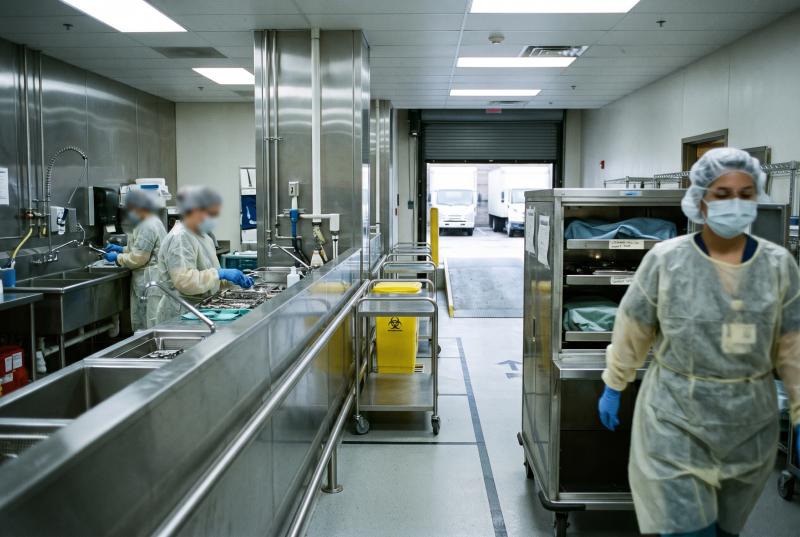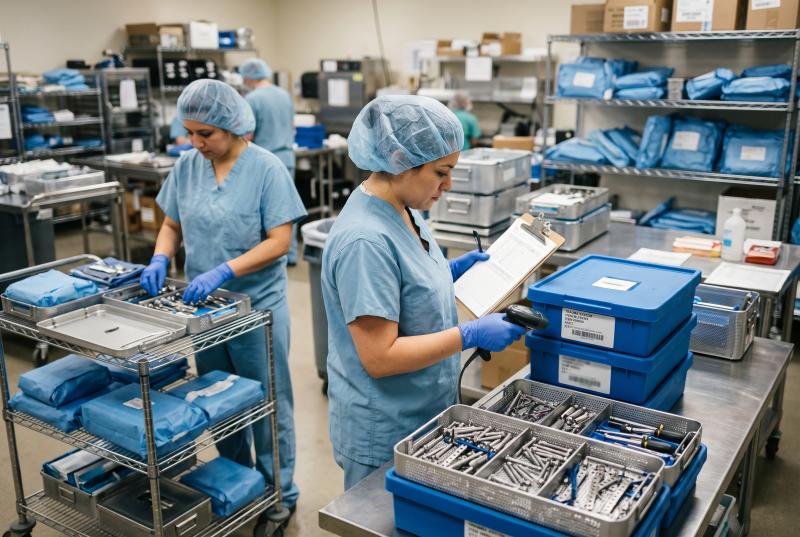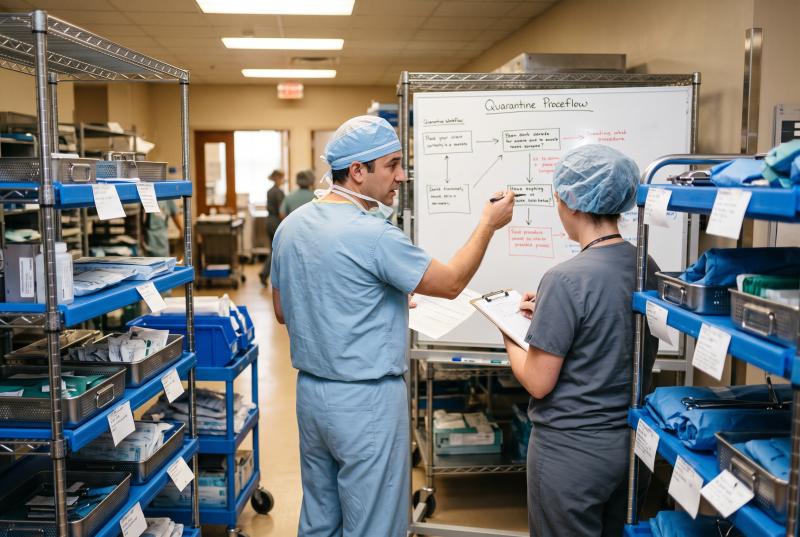
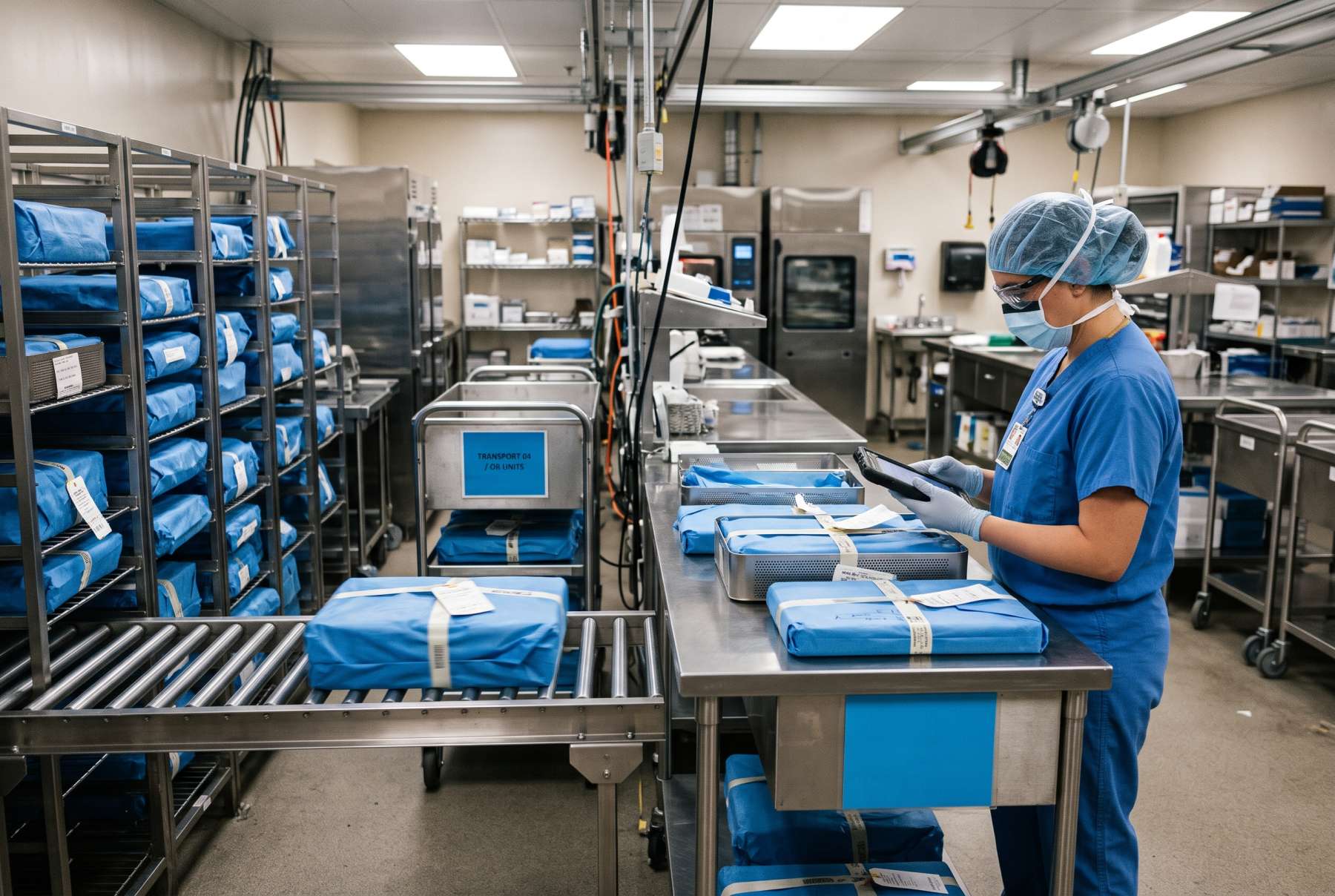
The word “ready” does too much work in medical device operations.
A tray can be marked sterilized and still be unavailable for the case that needs it. It can be sitting in the wrong staging area, waiting for a courier, separated from its implant inventory, or moving between a hospital and a 3PL with no shared record of custody. It can be physically present but not yet released through the hospital’s own clinical checks.
Those are different conditions. The problem is that many operating rooms, sterile processing departments, distributors, and field teams are still forced to represent them with one label, one spreadsheet row, or one text message.
Recent sterile processing disruptions have made the distinction harder to ignore. In October 2026, inspectors cited Central Maine Medical Center after finding contamination on four surgical instrument trays marked ready for use. The hospital halted or diverted some procedures while corrective work took place. The details are specific to that facility, but the operational lesson is broader: “ready” is not a single event. It is the end of a chain that has to be visible and defensible.
Reprocessing is a gate, not the whole journey
Sterile processing is often treated as the point where a tray becomes ready. In practice, it is one gate in a longer movement pattern.
A loan set may arrive from a manufacturer or distributor, enter decontamination, move through inspection and assembly, pass sterilization, wait for review, and then travel to a staging area or operating room. The same asset may be routed to another facility after the case, returned to a warehouse, or sent back through processing because the case was delayed.
Each step changes what the operations team needs to know. During decontamination, the question may be whether the tray entered the department at all. After sterilization, the question may be whether it has completed the hospital’s release process. Before the case, the question is whether the correct set is in the correct place, with enough time to resolve a missing component.
A status such as “sterilized” answers only one of those questions. It does not tell the scheduler whether the tray is available for a procedure tomorrow morning. It does not tell a field representative whether the set has left the hospital. It does not tell a 3PL whether the asset is still in its custody or already at the receiving dock.
The AORN sample policy for loaned instruments reflects this operational reality by treating receipt, tracking, decontamination, and processing as connected steps rather than isolated paperwork events. That distinction matters because the handoff after processing is where many teams lose the thread.
The dangerous gap is between “processed” and “available”
For the OR, availability is not the same as existence. A tray may be in the building and still not be usable for the scheduled case. It may be waiting for inspection. It may be in a clean storage area but assigned to another procedure. It may be complete except for an instrument that was removed for repair. It may have been released, but nobody knows which cart or staging zone contains it.
This is where a manual workflow creates false confidence. Someone checks a spreadsheet and sees the asset listed. Someone else calls sterile processing and hears that it was processed. A rep says the set was delivered. The scheduler assumes the case is covered. By the time the team discovers that the tray is not in the expected location, the opportunity to fix the problem has narrowed from a day to an hour.
The same issue appears during a correction or recall. The FDA’s medical device recall and early alert listings show how corrections can involve convenience kits, procedure trays, and components that move through multiple organizations. Finding the affected lot is only the beginning. The operator still needs to know which physical kits are at a hospital, which are in transit, which are in a 3PL warehouse, and which have already been used or returned.
A recall record can identify the affected product. It cannot, by itself, provide custody evidence for every physical asset. That evidence has to come from the movement history of the tray or kit.
This is why operational visibility should separate at least four ideas: where the asset is, what processing stage it has completed, whether it is assigned to a case, and whether the next handoff has happened. Those signals may support a readiness decision, but they do not replace the hospital’s clinical release process.
Transport exceptions are readiness exceptions
The most common response to a late or missing tray is still a phone tree. The rep calls the warehouse. The warehouse calls the carrier. The hospital calls sterile processing. Someone checks a dock log. Another person searches a rep’s vehicle. The work is not difficult because any single step is complicated. It is difficult because no one has the same live picture.
Transport is especially easy to underestimate. A tray that leaves sterile processing without a recorded destination creates uncertainty even if it eventually arrives. A kit that reaches a 3PL but is not assigned to an outbound shipment may be physically safe but operationally invisible. A courier delay may not matter for one case, but the same exception repeated across several ASCs can consume the margin built into the schedule.
For field teams, the distinction is practical. “Delivered to the hospital” is not a useful endpoint if the set is still somewhere between receiving, sterile processing, and the OR. For a distributor, “returned” is not enough if the tray has not been checked in and is unavailable for the next customer. For a 3PL, custody documentation is not just a compliance artifact. It is the information needed to decide whether a replacement shipment is necessary.
Automated location tracking changes the question from “who last saw it?” to “what exception needs attention?” A surgical tray or loan set can remain visible as it moves through the warehouse, hospital, sterile processing area, and return route. That does not make the asset clinically ready. It does make the operational uncertainty smaller, earlier, and easier to assign.
The economics are straightforward. Every unresolved location question consumes staff time, increases the chance of an emergency shipment, and makes the schedule less reliable. When a case is delayed because a tray was processed but not found, the organization pays for the lost capacity even if the tray is eventually discovered.
Readiness should be a chain of evidence
The better operating model is not a more elaborate green, yellow, or red status. It is a chain of evidence that follows the asset.
First, the team needs confidence that the correct tray or kit exists. Next, it needs to know where the asset is and who has custody. Then it needs the relevant processing state, the case assignment, and the next required handoff. If one of those links is missing, the asset may still be usable, but the organization is making the decision with incomplete information.
That chain also clarifies responsibility. Sterile processing owns the clinical and technical release process. The warehouse or 3PL owns the movement and custody record within its operation. Field teams own the coordination of delivery and return. Scheduling owns the question of whether the available asset supports the planned case. A shared view does not erase those responsibilities. It prevents each group from working from a different version of reality.
The recent Central Maine case is a reminder that a ready label cannot carry more certainty than the process behind it. A tray should not be considered operationally ready merely because a system says it was processed. The useful question is more demanding: can the team show where the asset is, what has happened to it, what remains to be done, and whether it can reach the case without another search?
That is the difference between a sterilized tray and a ready tray. One describes a completed step. The other describes a connected chain that the next person can see.