An ASC can add a procedure to its service line on paper in a few minutes. The harder part is making sure the required trays, implants, instruments, documentation, and people are ready when the case is actually scheduled.
That distinction matters as CMS continues pushing more procedures toward the ambulatory setting. On July 2, 2026, CMS issued its proposed CY 2027 Hospital Outpatient Prospective Payment System and ASC Payment System rule. The proposal would continue expanding the ASC Covered Procedures List and phasing services off the Medicare inpatient-only list. Industry reporting on the proposal counted 618 additions to the ASC list and more than 600 services continuing through the inpatient-only transition. The final policy may change, but the direction is clear: more procedures will be evaluated for lower-cost outpatient settings.
The natural response is to study payment rates, staffing models, anesthesia coverage, and clinical selection criteria. Those are necessary conversations. But for medical device distributors, manufacturers, 3PLs, and ASC operators, there is another question hiding underneath them: can the physical inventory move at the same speed as the case strategy?
A procedure is not ready because the code is payable
When a new procedure becomes viable in an ASC, the work does not end with a scheduling decision. Someone has to determine which trays are required, which components are owned, which are supplied by a manufacturer or distributor, and which implants need to be available for the surgeon's preferred technique.
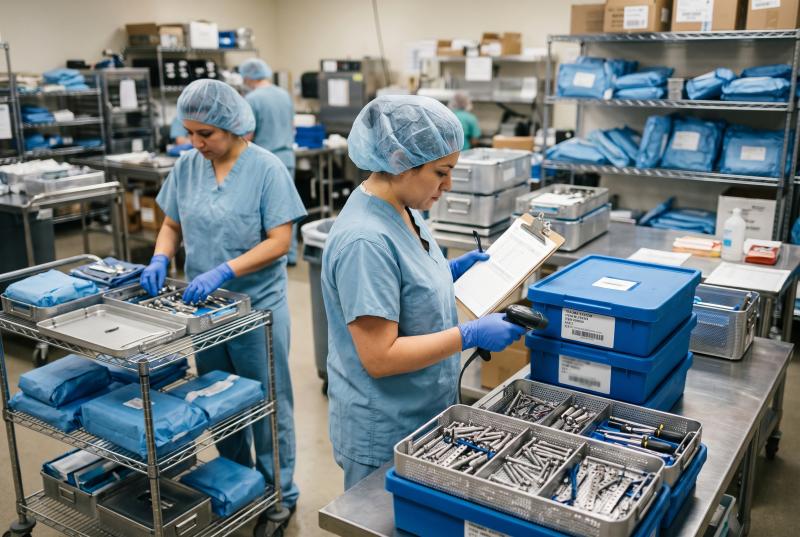
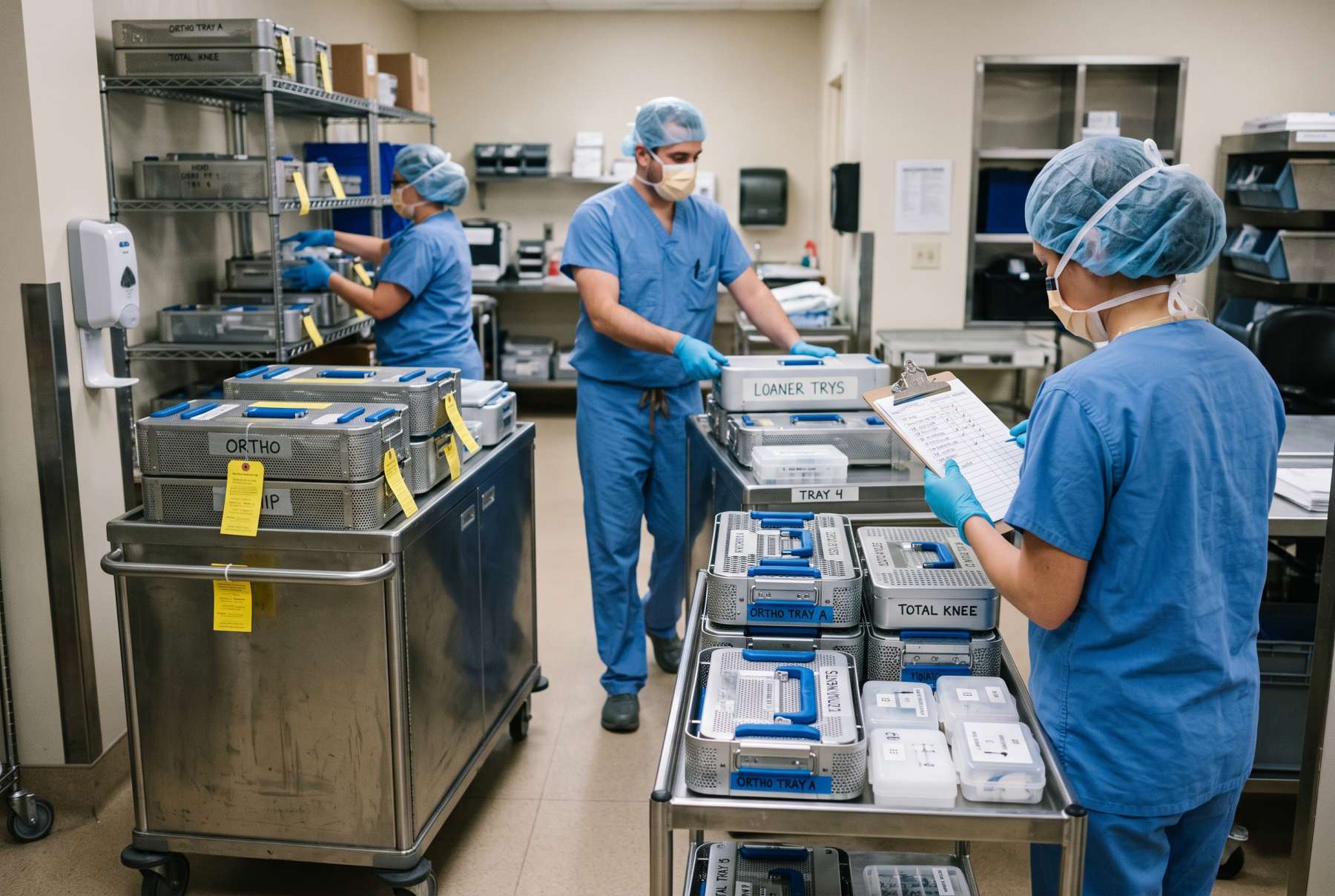
That inventory may be spread across several operating environments. A loaner set could be in a manufacturer warehouse, a regional 3PL, another hospital, sterile processing, a rep's vehicle, or an ASC that used it yesterday and has not yet completed its outbound handoff. An implant kit may be physically on site but incomplete. A tray may have cleared decontamination but not yet reached the clean side. A case can appear green in the scheduling system while the assets required to perform it are still moving through a network of handoffs.
This is why the most dangerous phrase in case planning is often “it should be here.” It usually means that one person has a recent memory of the asset, not that the organization has a shared, current view of its location and status.
The 2027 proposal affects approximately 6,400 ASCs, according to CMS's fact sheet on the proposed rule. That does not mean every center will add orthopedic, spine, cardiovascular, or other device-intensive procedures. It does mean more facilities will be assessing whether they can do so. The readiness problem will surface first in those assessments, before it shows up as a cancelled case.
More outpatient volume creates more inventory volatility
ASC growth is often described as a capacity story. Hospitals are under pressure to move appropriate cases out of the inpatient setting, physicians want predictable block time, and payers are looking for lower-cost sites of care. But the operational result is not simply more cases. It is more frequent movement of specialized assets between facilities with less slack in the schedule.
A hospital may have enough inventory to absorb a late tray or a delayed return. An ASC running a tight block schedule may not. A missing set does not just create a logistics problem. It can force a case to be moved, a surgeon to change technique, a rep to drive across a market, or a facility to hold staff and rooms while someone searches for a kit.
That volatility is especially difficult when the same assets support several customers. A distributor or manufacturer may be balancing competing requests across an IDN, multiple ASCs, and hospital accounts. A 3PL may know that a kit was scanned into a building but not whether it was sent to sterile processing, staged for a case, or placed in a return area. A field representative may know the kit was handed off but not whether the receiving team completed the next step.
Manual logs and phone calls can document some of these events after the fact. They are weaker at answering the operational question in the moment: where is the asset now, and is it ready for the case that depends on it?
That is the gap between electronic identification and operational visibility. The FDA's UDI program is intended to improve identification of devices, support recalls, and connect device use to clinical and supply chain data. Those are important capabilities. But a UDI or barcode does not, by itself, tell an operations team whether a tray is on the clean side of sterile processing, loaded on a truck, sitting in a rep's vehicle, or waiting at the wrong dock.
Identification answers what the asset is. Location and status answer whether it can support the case.
The readiness test is a chain, not a checklist
For an ASC preparing to add or increase device-intensive procedures, the useful question is not “Do we own enough trays?” It is “Can we prove the complete movement from planned case to usable asset?”
That chain has several points where the case can become vulnerable:
- Planning: The procedure is scheduled, but the required tray configuration and implant needs are not tied to the case.
- Allocation: A kit is assigned in a spreadsheet, but another customer or facility is also relying on it.
- Transportation: The set leaves a warehouse or hospital, but the receiving team has no shared arrival picture.
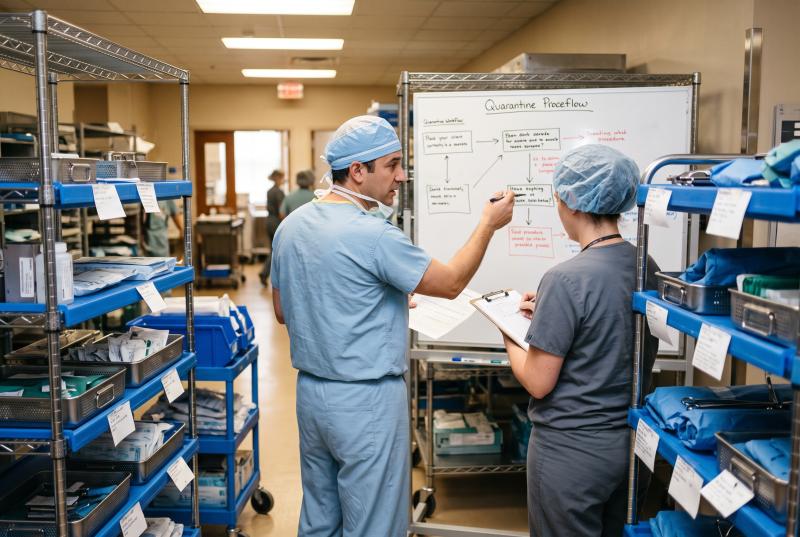
- Reprocessing: The asset enters decontamination and becomes effectively invisible to the people coordinating the case.
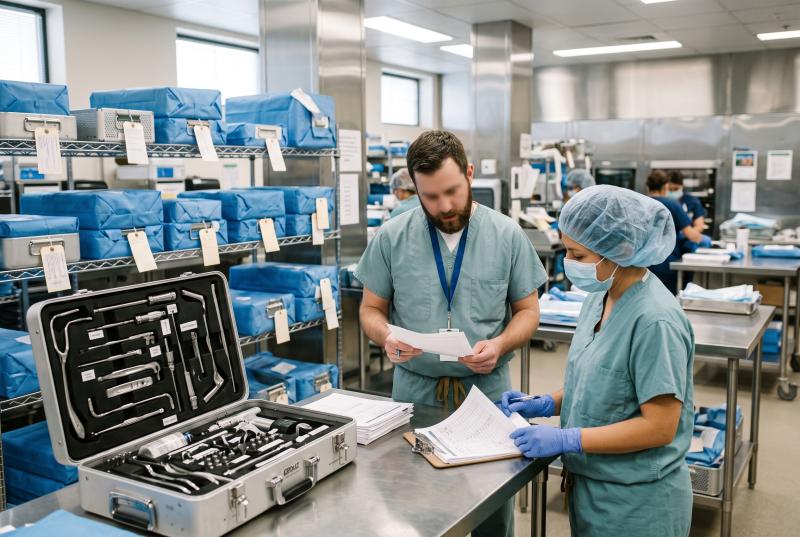
- Staging: The tray is at the facility, but it is incomplete, unsterilized, or in the wrong department.
- Return: The case is finished, but the asset remains at the ASC and is unavailable for the next assignment.
Each step can be recorded manually. The problem is that manual records create separate versions of reality. The distributor has one status, the field rep has another, sterile processing has a third, and the ASC scheduler is left to reconcile them under time pressure.
A better operating model treats case readiness as a live chain of custody and availability. The team should be able to see which assets are assigned to upcoming procedures, where they were last observed, whether they are in transit or in a facility, and which handoff remains incomplete. The point is not surveillance for its own sake. It is to expose the one missing tray before it becomes the reason a room, surgeon, and patient are waiting.
For distributors and manufacturers, this also changes how capacity should be measured. The number of trays in the fleet is less useful than the number of trays that are available, correctly configured, and positioned for the next demand. Utilization reporting can show whether inventory is sitting idle in one market while another facility is requesting an emergency loaner. A shared view can also reduce the habit of solving every shortage by buying another kit.
For ASCs, the same visibility supports a more honest growth plan. A center may be clinically capable of adding a procedure but operationally unable to support its device flow at the required cadence. That is not a technology failure or a staffing failure alone. It is a mismatch between the planned case volume and the physical movement system underneath it.
The next constraint may be the handoff
CMS's 2027 proposal is still a proposal. The final rule may add, remove, or modify procedures and payment policies. Operators should not build a forecast around every proposed code. But they should pay attention to the broader signal: outpatient growth is becoming a permanent operating condition, not an occasional scheduling adjustment.
As more procedures move into ASCs, the winning network will not simply be the one with the most inventory. It will be the one that can move the right inventory through warehouses, hospitals, 3PLs, sterile processing departments, and procedure rooms without losing the thread.
The practical test is simple. Before promising that a new case can be performed reliably, ask whether the organization can locate every required tray and implant kit without a phone tree. If the answer depends on a spreadsheet updated yesterday, a barcode walk tomorrow morning, or a rep who happens to know where the set went, the procedure is not operationally ready yet.
The ASC expansion story is often told as a question of site of care. For the teams moving medical devices, it is also a question of sight of care. The cases may be shifting outpatient. The assets still have to arrive, clear, stage, and return on time.