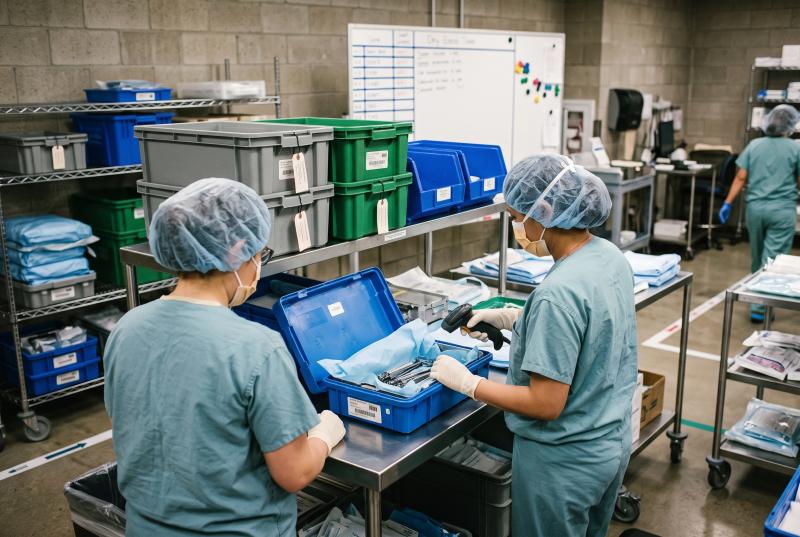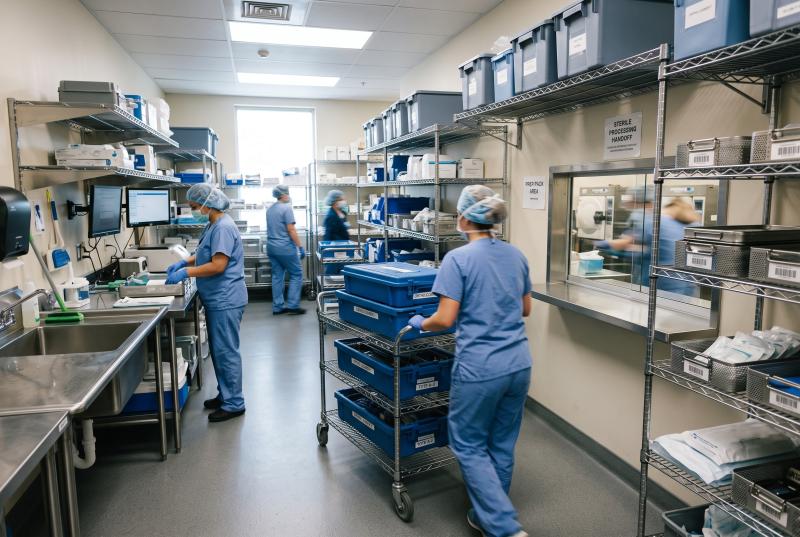
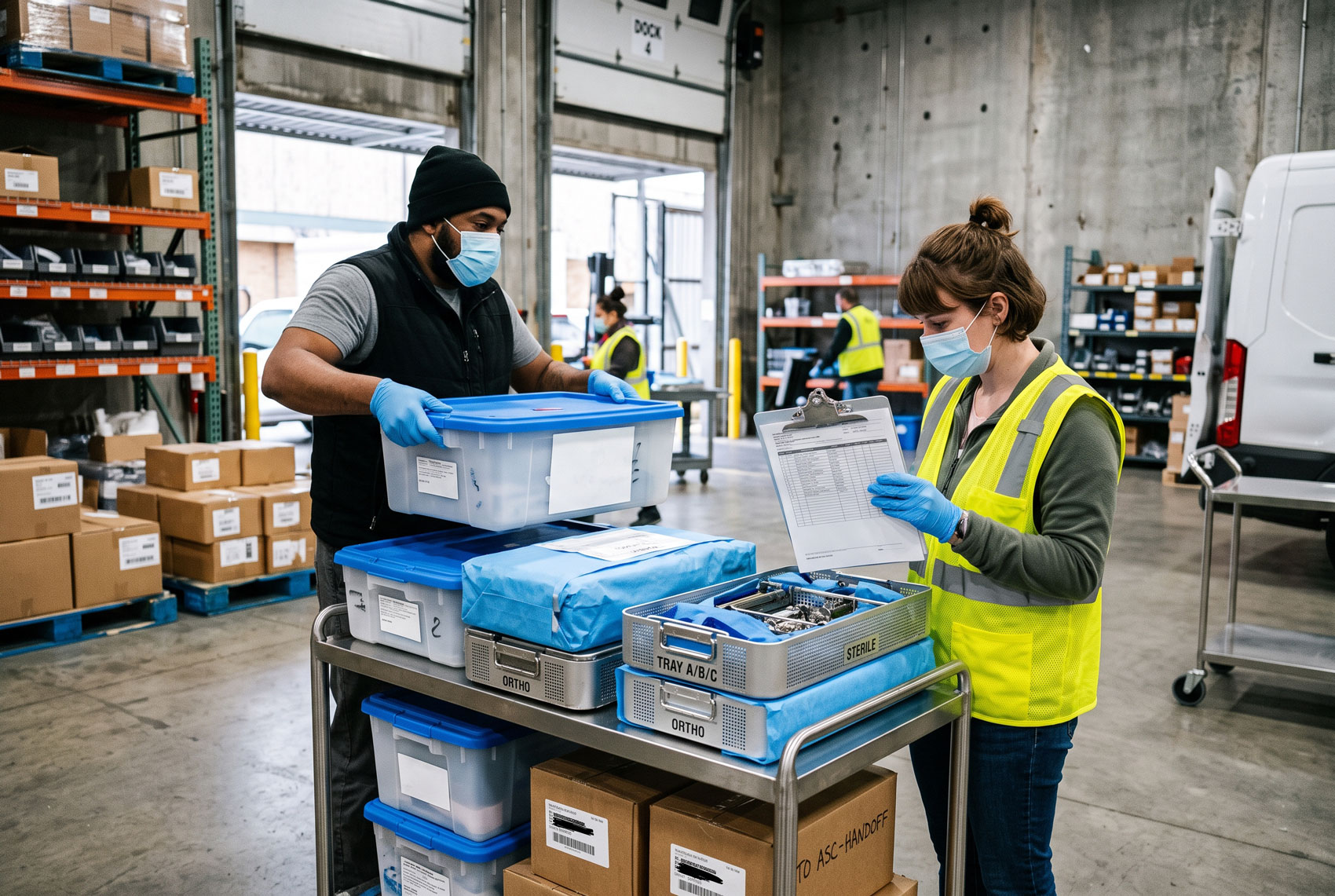
At 5:15 a.m., an orthopedic implant tote is sitting on a receiving dock that is not the dock listed on the delivery confirmation. The carrier says it was delivered. The warehouse says it left yesterday. The field representative says it was supposed to be at the ASC before the first patient arrived. Somewhere between those statements is a sterile tray, a missing component, and a case that is now being discussed as a scheduling problem.
That scene is becoming more common as procedures move into ambulatory surgery centers. The industry has spent years treating the ASC transition as a question of clinical capability and reimbursement. Those questions matter, but they are not the only constraint. A center can have the surgeon, the room, the anesthesia coverage, and the schedule. If the implant kit is sitting in a carrier hub, a hospital sterile processing department, a rep's vehicle, or the wrong ASC, the case is not ready.
The operational misconception is that a handoff is complete when someone signs for a box. In practice, a handoff is complete only when the next team can establish what arrived, where it is, whether it is usable, and what still needs to move.
More outpatient volume means more transfers, not fewer
CMS's calendar year 2026 final rule expanded the range of procedures eligible for ASC payment. The agency said it added 289 procedures after revising the ASC covered procedure criteria, along with another 271 codes removed from the inpatient-only list for 2026. The CMS 2026 OPPS and ASC final rule describes the change as a way to give physicians more flexibility over the site of care.
CMS then continued that direction in its CY 2027 OPPS and ASC proposed rule, proposing another phase-out of the inpatient-only list and a 2.4% update to ASC payment rates. The public comment period closed on August 31, 2026. Whatever the final policy looks like, the operating signal is clear: more procedures are being evaluated for outpatient delivery, and more facilities are being asked to perform them with tight same-day logistics.
That changes the shape of the supply chain. A hospital case may have more internal buffers. A large IDN can sometimes absorb a late tray by moving inventory from another campus or changing the order of rooms. An ASC usually has less room to hide a miss. Its schedule is compact, its storage footprint is smaller, and its financial model is more exposed to delays, idle staff, and unused block time.
The result is a handoff network that may include a manufacturer or distributor warehouse, a 3PL, a carrier, a field representative, a hospital sterile processing department, and the ASC itself. Every extra transfer creates another point where the asset can be received but not actually located, located but not inspected, or inspected but not released for the case.
The delivery confirmation is not the same as readiness
Most teams already have records for shipments. They have packing slips, tracking numbers, purchase orders, emails, barcode scans, and text messages. Those records answer useful questions, but they often answer them after the fact.
A delivery confirmation can show that a package reached a building. It cannot necessarily show that the correct tray reached the correct department. A scan can show that a set was processed. It may not show that the set was returned to the staging area, loaded onto the right route, or placed on the cart for tomorrow's case. A phone call can resolve an exception, but it also creates a private version of the truth that disappears when the person carrying the phone changes shifts.
For ASC operations, the important distinction is between a transaction record and a live operating picture. A transaction says, “Someone handled this asset.” A live picture says, “This asset is at the ASC, in the expected workflow, and available for the case.”
That difference becomes especially important with implant kits. A kit can be physically present and still not be ready. It may be missing a trial, waiting for inspection, held in decontamination, assigned to another surgeon, or split across multiple locations. The operational question is not simply whether the tote arrived. It is whether the team can make a reliable decision without opening a chain of calls.
The same logic applies to loaner trays. A set that is visible at the warehouse but has not moved is a risk. A set that has left the warehouse but has no confirmed destination is a larger risk. A set that is at the hospital but cannot be found by sterile processing is an even more expensive version of the same problem.
Accountability has to travel with the asset
Each handoff should answer four questions: What asset moved? Who accepted it? Where is it now? What is the next required action?
The first question sounds basic, but it is where many operational records become vague. “Orthopedic trays” is not enough when a case depends on one specific system, configuration, or implant family. The second question matters because responsibility changes at the point of transfer. A warehouse may be accountable for dispatch, while a 3PL is accountable for custody in transit, the ASC is accountable for receiving, and sterile processing is accountable for making the set available for use.
The third question is the one most teams struggle to answer in real time. Not “where was it last scanned,” but “where is it now?” That requires automated visibility across the places where assets actually spend time, including warehouses, hospitals, ASCs, sterile processing areas, staging zones, and vehicles or transfer points where the workflow allows it.
The fourth question prevents visibility from becoming passive reporting. If a tray is at an ASC, the next action may be inspection. If it is in sterile processing, the next action may be sterilization. If it is still at a 3PL, the next action may be routing. The point of location data is to support the decision attached to that location.
This is also why manual visibility breaks down under pressure. Barcode walks and spreadsheet updates are useful controls in a stable process, but they depend on someone remembering to perform them at the right time. A phone tree can identify an asset eventually, but it does not create shared accountability. The more the ASC model compresses the time between delivery, processing, and case start, the less tolerance there is for information that arrives late.
The financial case is hiding inside the schedule
ASC leaders are already dealing with pressure on implant economics. A Becker's ASC report on implant costs noted that consignment and rep-managed inventory models can widen the gap between when ASCs incur costs and when they are reimbursed. That gap makes every avoidable movement, duplicate kit, emergency shipment, and unused block more visible to the operating margin.
It is tempting to frame tracking as an inventory project. For an ASC, the stronger frame is case economics. The cost of not knowing where a kit is may show up as an overnight freight charge, a second set pulled “just in case,” staff time spent searching, a rep driving across town, or a delayed case that pushes the rest of the schedule.
Movement data can also improve the inventory conversation, but only if it is kept separate from utilization data. A tray that moves frequently is not automatically a tray that is used frequently. It may be circulating between facilities, sitting in sterile processing, or traveling empty because the network lacks confidence in its location. Movement reveals friction and transfer patterns. Utilization reveals whether the asset is supporting cases. Combining them too early can lead to the wrong conclusion and the wrong inventory decision.
For distributors, manufacturers, and 3PLs, the same distinction matters. A customer may ask for more loaner inventory when the real issue is poor handoff control. Another may reduce inventory when the actual problem is that kits are moving through the network but not being seen. A shared, always-on picture of trays and implant totes gives each party a better basis for deciding whether the answer is more assets, better routing, or fewer gaps between custody and location.
The ASC transition is often described as a shift in site of care. Operationally, it is also a shift in the burden of certainty. The smaller the facility and the tighter the schedule, the less acceptable it is to treat “delivered” as a synonym for “ready.”
The next case readiness test will not happen when the surgeon walks into the room. It will happen earlier, at the handoff where the kit changes custody. The organizations that manage that moment well will not necessarily have the most inventory. They will have the clearest answer to a more practical question: where is the asset, and what must happen before the case can depend on it?