
The important part of CMS-1849-F is not a new scanner requirement. It is the direction of travel.
In the FY 2027 IPPS final rule, CMS finalized the addition of a Unique Device Identifiers for Implantable Medical Devices measure under the Medicare Promoting Interoperability Program. Beginning with the calendar year 2027 EHR reporting period, eligible hospitals and critical access hospitals will attest that they used certified electronic health record technology to electronically capture and store the complete UDI for each implantable medical device subject to UDI requirements and used for patient care delivery. The measure includes an exclusion for facilities that implanted five or fewer covered devices during the applicable year. CMS FY 2027 IPPS Final Rule page and FY 2027 final rule. (govinfo.gov)
That distinction matters for every organization that touches an implant before it reaches the operating room. CMS is not saying that every hospital must deploy barcode scanning, Bluetooth Low Energy, real-time location systems, or any other particular capture method. The rule is focused on the result: complete device identity stored as discrete, usable data in the patient record. The practical implication is that the data has to be reliable before someone needs it in the chart.
The implant record starts before the procedure
In the clinical workflow, the last scan often gets all the attention. A circulating nurse or implant coordinator identifies a device, confirms that it belongs to the case, and makes sure the device information is associated with the patient record. That is the visible moment of implantation.
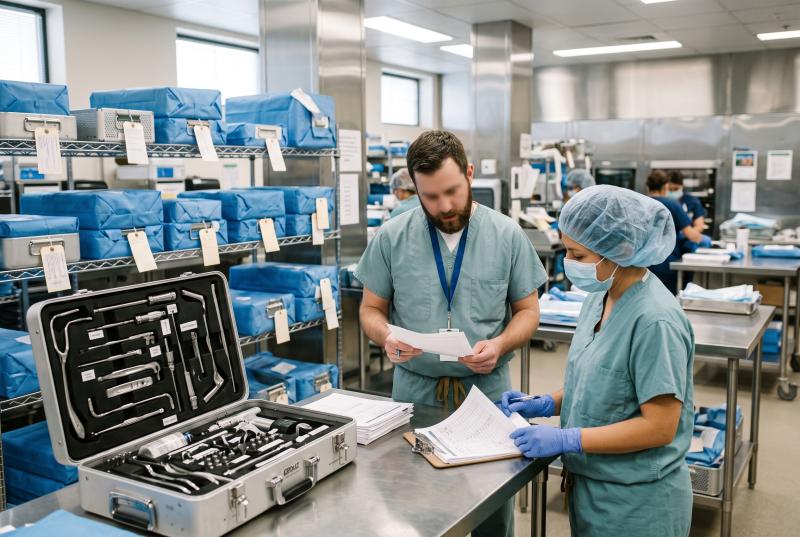
Operationally, it is not the beginning of the device's story. The device may have started in a manufacturer warehouse, moved through a distributor, been assigned to a hospital account, placed in an implant kit, packed into a tote, delivered for a scheduled case, and held in a location that changed more than once before use. Along the way, the organization may have managed the GTIN, lot or batch number, serial number, expiration date, quantity, ownership, case assignment, and status.
When those details are maintained digitally, the point-of-use record can be more than a transcription exercise. The hospital can associate the implanted device with the patient and procedure while the manufacturer or distributor can retain the operational history that explains where the device came from and how it reached the case. That creates a more complete chain from supply activity to clinical use.
The alternative is familiar. A label is peeled from a package and stuck to a form. A serial number is entered manually into one system and scanned into another. A lot number is copied from a sticker that is difficult to read. A case record is closed while inventory remains unchanged because the device was issued from a tote or tray rather than a formal pick location. The clinical record may eventually contain something, but the broader supply chain still has gaps.
UDI data is only useful when it stays structured
A UDI has two basic parts. The device identifier identifies the labeler and the specific device version or model. The production identifier can include information such as the lot or batch number, serial number, expiration date, or manufacturing date when those elements appear on the label. The ONC implantable device list criterion is designed to support recording, parsing, and associating those elements with a patient's implantable device record. (healthit.gov)
That structure is the difference between device data and device paperwork. A scanned identifier can be searched, validated, reconciled, exchanged, and connected to other records. A photograph of a sticker or a free-text note is much harder to use for a recall review, a warranty question, an inventory audit, or a follow-up encounter.
The FDA's Global Unique Device Identification Database is part of that foundation. GUDID is a reference catalog for devices with UDIs. It contains the device identifier and associated device information, while production identifiers such as lot and serial number remain tied to the specific labeled item rather than being stored as part of the GUDID record. FDA GUDID overview. (fda.gov)
For hospitals, this means the objective is not simply to scan something at the end of the case. The objective is to capture the right fields, preserve their meaning, and make them available where they are needed. For manufacturers and distributors, it means that item masters, shipment records, kit contents, and case activity become part of the same data conversation. The clinical record can only be as dependable as the upstream identity data feeding it.
What this looks like across a medical-device workflow
Hansel Medical's Inventory Management functionality provides a practical example. A medical device can be digitally identified when it enters the inventory ecosystem by scanning the GS1 barcode or DataMatrix code on the device or package. The scan can decode identifiers such as GTIN, lot or batch, serial number, and expiration date. Through an integration with the FDA's GUDID, the scanned device identifier can be enriched with authoritative device information rather than relying entirely on local descriptions or manual item-master maintenance.
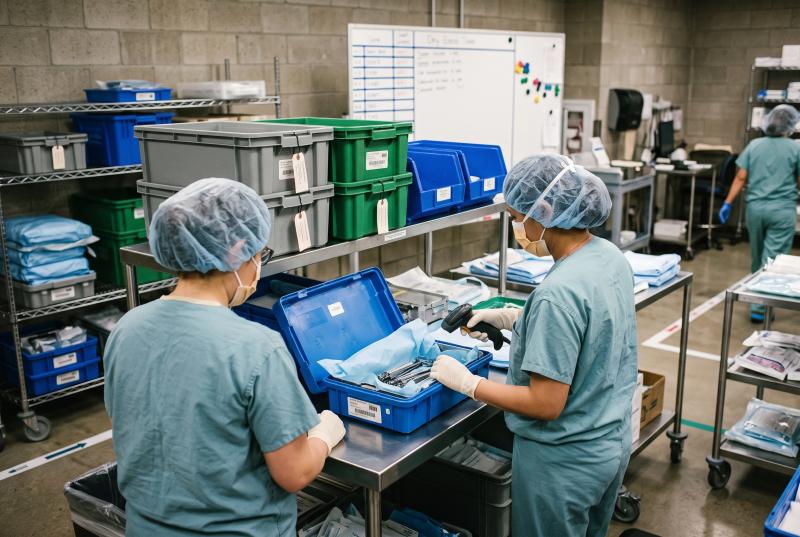
From there, the operational record can follow the device through the workflows that already exist around surgical inventory. The item can be associated with the appropriate tote, tray, implant kit, or case. The case record can show what was packed, what was missing, what moved, and what was used. A distributor or manufacturer can see the movement history of the asset or kit, while the provider can work from a more reliable record of what reached the procedure.
That does not mean Hansel replaces the hospital's EHR, and it does not mean a supply-chain platform alone satisfies the CMS measure. The clinical system still has to capture and store the implant information in the patient record. The operational point is different: the supply chain can reduce the amount of information that has to be recreated at the point of care.
This is where automated inventory capture matters. If every downstream user has to rescan the same package, retype the same serial number, or reconcile the same sticker against a different item description, the process creates opportunities for mismatch. If the device identity is captured once and carried through inventory, case, and usage workflows, the final clinical association becomes a controlled handoff rather than a last-minute memory test.
Real-time asset tracking adds another layer, but it should not be confused with the UDI requirement. Location visibility can help teams know where a tray, tote, loan set, or implant kit is before a case. It can help a distributor understand whether an asset is at a warehouse, hospital, sterile processing department, or field location. It cannot, by itself, prove which implant was used in which patient. That proof depends on accurate device identity and a reliable association to the clinical record.
The operational test is the handoff, not the technology
Hospitals should read CMS-1849-F as a prompt to examine the handoffs between supply chain, the operating room, and the EHR. Where does device identity first enter the system? Is the production identifier preserved, or does it disappear after receiving? Can the organization distinguish the device that was available from the device that was actually used? Can a distributor answer where a serialized item went without searching email, spreadsheets, and shipping paperwork?
Manufacturers and distributors face the same test from the other side. Their records may already contain the device, lot, serial, expiration, location, and case information. The question is whether those records are structured and interoperable enough to support the provider's point-of-use workflow. A device journey that is digitally visible through the warehouse but becomes manual at the hospital is not a complete journey.
The strongest response is not to buy technology because a rule mentions UDI. It is to make device identity durable across the workflow. Capture it when the device enters inventory. Keep it connected to the tray, tote, or case that carries it. Update status when it is issued, returned, opened, or used. Pass the structured information into the clinical record through the systems responsible for patient documentation.
CMS-1849-F makes the clinical expectation clearer: the device actually implanted should be represented electronically as a device, not merely described in a note. The operational lesson is broader. If hospitals, manufacturers, and distributors want reliable implant data at the point of care, they have to stop treating that moment as the beginning of the record. The record starts with the device, and it gets stronger every time the supply chain preserves its identity instead of handing it off as paper.