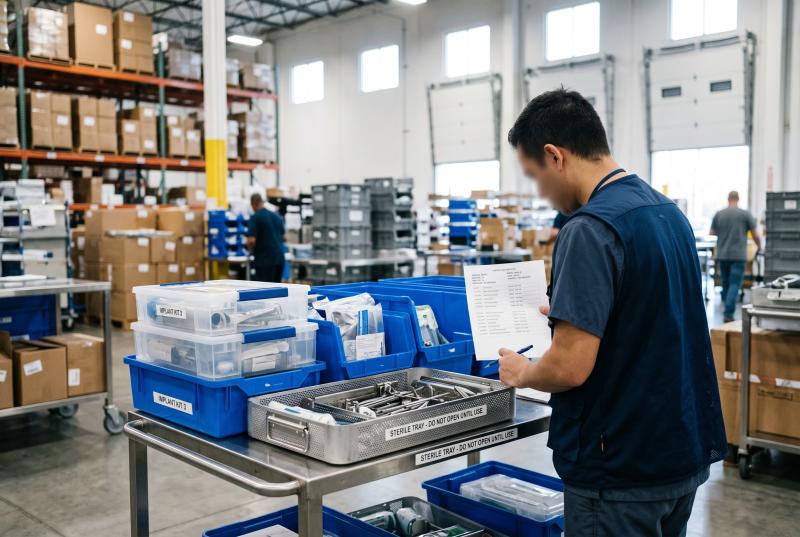

At 6:15 on a Tuesday morning, a distributor’s warehouse can look perfectly organized. Trays are stacked by manufacturer. Implant totes are staged by route. A carrier has already arrived at the dock.
Then one case changes.
A set that was supposed to leave for an ambulatory surgery center is still showing as available in the warehouse system. A field rep says it was picked up yesterday. The hospital says it never arrived. The 3PL has a delivery scan, but nobody can say whether the scan belongs to the complete set or only the outer carton. Someone starts calling.
That scene is not a dramatic regulatory failure. It is a routine visibility failure. But with the FDA’s Quality Management System Regulation now in effect, routine visibility failures deserve a more serious look.
The QMSR became effective on February 2, 2026. It incorporates ISO 13485:2016 into 21 CFR Part 820, and the FDA now uses a revised inspection process for medical device manufacturers. The rule applies to finished device manufacturers that intend to commercially distribute devices in the United States. (fda.gov)
QMSR does not say every surgical tray needs a real-time location tag. It does not turn a hospital’s loaner workflow into a device manufacturing process. The important point is more practical: manufacturers remain accountable for the quality system around their products, including the controls they use with suppliers and outsourced activities. (fda.gov)
That makes the dock, the rep’s vehicle, the 3PL handoff, and the sterile processing receiving area part of the conversation. Not because the regulation has suddenly discovered logistics, but because quality records are only as reliable as the operating process that creates them.
The inspection question is not only “Where is the record?”
Medical device organizations have spent years building document control, complaint files, CAPA workflows, supplier qualification programs, and electronic quality systems. Those controls matter. They are also easier to point to than the physical movement of assets through a fragmented network.
A quality team can produce a procedure for loaner set handling. It can show a supplier agreement, a training record, and a completed checklist. The harder question comes later: when the set moved from the manufacturer to a distributor, from the distributor to a hospital, and from the hospital into decontamination, what objective evidence shows that the right set moved through each step?
That is where many operations still rely on a patchwork of spreadsheets, barcode events, email threads, text messages, and memory. Each tool may capture a piece of the story. None necessarily provides one shared account of custody, location, status, and readiness.
The distinction matters. A scanned barcode can prove that someone scanned something. It may not prove where the asset sat for the previous 18 hours, whether the complete tray was present, or whether the set was routed to the correct facility after a schedule change. A phone call can clarify a problem. It cannot create a reliable history of every similar movement.
This is not an argument that every operational record needs to be perfect. It is an argument that teams should stop confusing activity with control. A process that generates many touches can still leave the organization unable to answer a basic question.
Outsourcing does not outsource uncertainty
The modern device supply chain is built on handoffs. Manufacturers use distributors. Distributors use carriers and 3PLs. Field teams move consigned inventory between accounts. Hospitals and ASCs receive loaner sets into environments with different receiving windows, sterile processing practices, and local rules.
Each handoff creates a decision point. Was the asset received? Was it complete? Was it sent to decontamination? Was it cleaned and available, or merely somewhere inside the facility? Was it returned to the warehouse, transferred to another rep, or left behind after a case?
The obvious explanation for weak traceability is usually that somebody failed to scan. Sometimes that is true. More often, the deeper issue is that the process depends on every person remembering the right action at the right moment, across several organizations, while the schedule is moving underneath them.
That is a system design problem.
FDA materials on QMSR emphasize risk-based oversight, records, supplier controls, and the effectiveness of the quality system rather than a single preferred software tool. (fda.gov) A manufacturer can satisfy its obligations in different ways. But if a critical operational control depends on a rep replying to a text, a warehouse clerk updating a spreadsheet, and a hospital employee remembering to send a photo, the organization should be honest about the risk it has accepted.
For distributors and 3PLs, this is especially important. They may not own the product design or the manufacturer’s QMS, but they often control the moments when inventory becomes visible or disappears. Their records can become the evidence that a product was handled, routed, held, received, or returned as intended.
A carrier scan is useful. A shared operational picture is stronger.
Real readiness starts with the physical asset
The best compliance conversation does not begin with a dashboard. It begins with the asset and its failure modes.
For a surgical tray, the questions are concrete:
- Can the team identify the set without opening the container?
- Can it distinguish an available set from one already committed to a case?
- Can it see whether the set is in a warehouse, hospital, ASC, sterile processing department, or field vehicle?
- Can it tell whether the asset is moving, waiting, being processed, or missing a required step?
- Can operations, field teams, and clinical staff see the same status without rebuilding the story by phone?
Those are operational questions, but they have quality consequences. When a set cannot be located, staff may substitute another set, rush a shipment, delay a case, or make a decision based on an incomplete inventory picture. When a set is found late, the organization may still not know whether it is ready for use.
This is why visibility that stops at the warehouse is not enough. The asset has to remain identifiable through the parts of the workflow where it is most likely to become disconnected from the record. For reusable surgical assets, that includes sterile processing. A tag that cannot remain with the asset through autoclave creates a new blind spot exactly where the physical workflow is most complex.
Hansel’s approach is built around that continuity: real-time tracking for surgical trays, loan sets, implant totes, and related inventory, using an autoclavable tag that stays with the asset through sterilization. The practical value is not the tag by itself. It is the shared live picture that connects warehouse staff, field reps, distributors, 3PLs, hospitals, ASCs, and sterile processing teams without a per-seat tax. The service is priced per asset, which keeps the economics tied to the inventory being protected rather than the number of people who need visibility.
That distinction is worth keeping in view as QMSR settles into everyday inspection reality. A new regulation can improve the framework. It cannot repair a handoff that nobody can see.
The question for medical device operations is therefore not simply, “Do we have a procedure?” It is, “When the asset leaves our direct control, can we still prove what happened next?”
If the answer depends on a spreadsheet updated after the fact, a barcode scan performed only when someone remembers, or a chain of calls between people who are already trying to solve the next problem, the gap is not just administrative.
It is the distance between having a quality system on paper and having a controlled operation in the field.