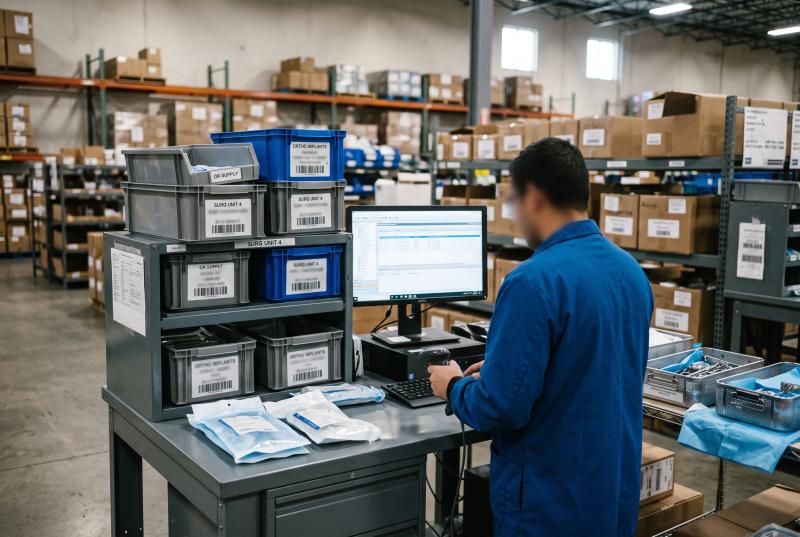

A recall notice can tell a medical device distributor which component is affected. It cannot, by itself, tell the warehouse which procedure kits contain that component, which kits are sitting at an ASC, which ones are in sterile processing, or which ones have already been opened for a case.
That distinction matters more as kits become the unit that moves through the healthcare supply chain. The physical object on the dock may be a convenience kit, anesthesia tray, epidural kit, implant tote, or loaner set. Inside it are individual devices with their own manufacturers, lot numbers, expiration dates, and recall status. The outside label may identify the kit. The risk may sit several layers down.
The FDA's recall and early alert listings show why this is not a theoretical concern. In August and September 2026, the agency listed multiple convenience kit corrections involving components from companies such as Medline, BD, B. Braun, ICU Medical, and others. The list included a September 2 correction involving kits containing BD ChloraPrep applicators and a September 10 correction involving epidural kits containing Spectra Medical devices. The details differ, but the operating question is the same: where are the physical kits now, and what happened to their contents?
For distributors, manufacturers, hospitals, ASCs, and 3PLs, recall readiness is becoming less about finding a line in a product master and more about reconciling a moving physical network.
Identifying the component is only the first step
Most recall processes begin with a list. Someone receives a manufacturer notice, searches an item master, checks a lot number, and sends instructions to the relevant sites. That is necessary work. It is not the full work.
A kit can change state several times before anyone responds to the notice. It may be assembled at a manufacturer, shipped to a distributor, placed in a hospital's supply room, sent to sterile processing, opened for a case, partially used, returned, or redistributed to another site. A single kit record rarely captures all of those transitions unless the organization has deliberately connected the kit, its contents, its location, and its activity history.
This is where the usual explanation becomes incomplete. The problem is not always that a team lacks the recall notice. The problem is that the notice arrives in a network where inventory records describe what should exist, while operations need to know what physically exists and where it is sitting today.
That gap is especially visible when the affected device is nested inside a larger package. A recalled component may be held in a central warehouse, a hospital's clean storage area, a rep's vehicle, a third-party logistics location, or an opened kit that no longer matches its original contents. A spreadsheet can show the kit's assigned site. It usually cannot show whether the kit is still complete, whether it crossed a sterilization workflow, or whether it moved after the last manual update.
Quarantine depends on movement history
Recall response is often described as a communication exercise. In the field, it is a movement exercise with a compliance deadline attached.
The team has to stop the affected asset from being used. That means someone must identify the asset, find it, place it on hold, document the hold, and make sure the next person in the chain sees the same status. If the asset is not where the record says it is, every step becomes a phone call. If the kit has been split, the team must determine which piece is missing and whether the affected component was used, returned, or discarded.
The operational record needs more than a product description. It needs the asset's last reliable sighting, current site, time at that site, movement history, and relationship to the kit or tote in which it travels. It also needs a way to record an exception when the physical condition no longer matches the planned inventory.
This is one reason the sterile processing environment exposes weak recall processes quickly. A tray or kit may pass through decontamination, preparation, sterilization, clean storage, the OR, and return handling without a single person owning the whole chain. The 2026 HSPA conference discussion on scan fatigue highlighted how tracking systems can create documentation gaps when every handoff depends on another manual scan. Infection Control Today’s report on scan fatigue described the problem as a workflow and engagement issue, not simply a training issue.
That distinction matters for recalls. Adding another scan to a broken process may produce another incomplete record. Visibility that persists through the dock, sterile processing, and the autoclave gives the organization a different starting point. It can show where a tagged tray, loan set, or implant tote was last reliably seen without asking an already busy technician to reconstruct the route from memory.
The practical test is not “Did we notify everyone?”
Notification is easy to count. Closure is harder.
A distributor may be able to report that every account received the recall email. A hospital may be able to show that the item was removed from its preference list. A manufacturer may have a completed response form from the customer. None of those answers proves that every affected physical kit was found and reconciled.
A better operational test is more specific:
- Can the team name every kit, tray, tote, or asset that may contain the affected component?
- Can it show the last reliable location of each physical asset?
- Can it distinguish an asset that is on site from one that is in transit or has not been seen recently?
- Can it record whether the kit is complete, opened, quarantined, returned, or missing an item?
- Can the same status be seen by the warehouse, field team, hospital, ASC, and 3PL handling the asset?
These questions move recall work from an email campaign to an exception workflow. The item is not complete because someone changed a spreadsheet cell. It is complete when the physical asset has been located or formally accounted for, the hold is visible, and the next action has an owner.
That model also aligns with the direction of supplier relationships across hospitals and ASCs. A September 4 report from the Journal of Healthcare Contracting emphasized that supplier operations can either reinforce or undermine reliability between care sites and their partners. A shared software connection is not enough if each organization still has a different answer to where the physical kit is and what it contains.
What a stronger record looks like
The useful record is not necessarily the most complicated one. It is the one that follows the asset through the places where visibility usually disappears.
For a surgical tray, loan set, or implant tote, that may mean a named asset record connected to its site, movement history, activity trail, and kit contents. It may include the procedure or work item that requires the asset, a missing-item check before release, and a hold that prevents the workflow from advancing while the kit is incomplete. It may also include the sterilization history needed to understand whether the asset passed through processing after the last known status.
Automated presence can reduce the need for barcode walks and repeated calls, but automation is not the point by itself. The point is to preserve enough operational context that a person can make a decision without starting a new investigation. Is the kit at the hospital? Is it still in the warehouse? Did it leave the site? Has it been seen since the recall was issued? Does the contents record need to be reconciled?
The same logic applies outside a recall. If an ASC is waiting on a loan set, the team needs to know whether the set is late, misrouted, incomplete, or sitting in a clean room under another name. If a distributor is balancing utilization across accounts, it needs movement and availability rather than a static count. If a 3PL is handling multiple manufacturers, it needs a consistent asset picture that does not depend on which customer service representative answers the phone.
The timely lesson from the recent convenience kit corrections is not that every kit is unsafe or that every recall is poorly managed. It is that packaged inventory hides operational relationships. The affected device may be easy to name while the physical kit is difficult to find.
For medical device operations, recall readiness should therefore be judged by the last physical question, not the first administrative one. Do not stop at “Which item is affected?” Ask, “Which actual kits contain it, where are those kits now, and who owns the next move?”
That is the difference between having a recall list and having control of the network the list is supposed to protect.